Metcalfe Models 00/HO Scale Village Shop & Cafe

I built the second building from Metcalfe Models that i bought a while back. The first manor house was a bit on the small side to fit in with my other scratch built Normandy buildings so i was not too enthusiastic about this one. But i was happy to be surprised with how this turned out. Scale size is always a problem, especially with buildings. I did purchase one as a trial from Loic Neveu, who makes great looking stuff, but it was tiny! I reckon it would fit better with 15mm or 1/100 scale. My home made village all comes in around 40mm per storey or 120mm minimum height for a two storey building with roof. Plus the chimney pots and 3-5mm of base. This Metcalfe village shop is 110mm in height to the top of the chimneys which is just big enough to fit in with my existing buildings without looking shrunken and dwarfish. Once you stick him in with other scenery you don’t notice the slightly smaller scale.

So onto the model. I really like these card kits. They come in super solid card stock and are really fun and easy to build. A clear instruction sheet is provided and the card pieces are very clearly marked and self explanatory. It makes a nice change for an evening’s modelling excitement. The card does a look a bit too clean and tidy, so i find basing them and throwing some brown paint around does help them blend into the “real world” a bit. While i am super keen on building my own terrain from scratch having a few of these guys adds some variety and speeds up the process a bit too. Building my own takes me weeks and weeks. For around $15 – 17 per house they are very good value compared to other resin or plastic options. I have my beady eyes on a couple of other Metcalfe kits, the terraced houses and corner store may be added to my collection. You should check them out, even more so for you Cold War and Modern wargamers, as they will fit better in that period than in Normandy 1944.

IBG Models Chevrolet C15A No.13 Cab in 1/72 scale

IBG 72015 1/72 Chevrolet C15A No.13 Cab Australian Pattern Wirel

These kits from Polish company IBG are just always a total pleasure to build. This is only my second truck from their range but i it was just as awesome as the first one. They come packed in a way oversize box with just a couple of sprues. Detail is great and the kit goes together very nicely with no issues. You don’t get any crew so i added my usual driver from AB figures. Always remember to build and paint the interior of the cab before putting on the roof and the driver in. I have made this mistake before……
Not much else to say. I really enjoyed making this kit. if you want a good range of smaller trucks then look no further than IBG. I painted mine in standard olive green and added some dirt and dust and mud. Great fun. They have some very cool looking US trucks too which i want to get my hands on. You always need trucks and plenty of them. Some lucky officer will get to swan around in this baby.


Trumpeter Jagdpanther in 1/72 scale

Trumpeter produce a huge range of 1/72 scale tanks and vehicles and where i am in Australia they are very affordable and easy to find. Only $10 a pop from my www.hobbyeasy.com, which i think is just great value. The Jagdpanther is a very cool tank and although not used in great numbers in Normandy i still really wanted to build one.

Previously i had built some Jagdpanthers from the English company Armourfast, but to be honest, this Trumpeter kit is 100% far and away totally better in every department. The kit is quite a simple build. The running gear goes together quickly with a couple of dozen wheels. I left the vinyl/rubber tracks off so i could paint them separately before attaching them to the tank later. The hull of the tank has plenty of great detail to add including spare tracks on each side, plus it has schurzen plates to add if you like. On this version i decided to leave them off so you can see the running gear more clearly. Some good decals are provided, with two different choices of numbers for the side of the tank.

I painted this by hand in a usual three colour camouflage scheme, but tried a brighter camo green than i normally use. I also tried some new techniques and products I hadn’t tried before. Firstly i bought some MIG products washes for British and German tanks. Normally i just use some raw/burnt umber mixed with a touch of black for a wash. I gave the tank a gloss varnish after finishing the camo scheme and then gave it a wash with the MIG wash for German vehicles. What a difference! I would recommend grabbing some of these as the effect is so much better than just the regular paint wash i was using.

I also tried some chipping weathering effects with a sponge that i had read about. This worked quite well with a contrasting paint colour to my tanks paintwork (i used burnt umber and raw umber mainly). I made sure i didn’t over do it. Also after reading a tutorial by Piers Brand on how he uses weathering powders on tanks i decided i wanted to try them out too. So another trip to BNA Model World, i bought a bunch of weathering powders, again from MIG, and used them on the tracks and running gear. Using them sparingly and keeping the effects subtle they certainly improve the look of the vehicle.

So i was very happy with the new techniques and products i tried this week. You can see the results in my finished Jagdpanther below.

Ploughed Fields Corrugated Card

I was destroying some card board boxes to put into the recycling the other day but then was suddenly struck with a terrain vision in my backyard. As i tore up the reinforced card board i remembered something i read somewhere about making ploughed fields out of corrugated card and thought i would give it a try. You can never have enough rural scenery, and my painted carper tiles get a bit stale.

This is about the easiest terrain build you can hope for. Clean up your corrugated card by removing the top layer of card leaving the furrowed bit. Then glue to an appropriately sized piece of MDF. You can make any size you like. The card is blended to the MDF using some no more gaps/caulk/arylic filler around the edge. I gave the edging a good cover of PVA and sprinkled with sand for texture. I also did some PVA glue and sand sprinkles on the furrows too for effect. A good dark brown spray from the can followed by a couple of lighter brown dry brushes adds some texture to the surface. The usual green flock around the edges plus some in the field for variety. I did have some warping issues with the MDF which i sorted using some heavy weights and also painting the bottom of the terrain.

Together with some hedges below the results are pretty convincing. For almost zero cost this is a great addition for my table. I just need a tractor and some hay bales now.

Plastic Soldier Company Sherman Firefly in 1/72 scale

The Sherman Firefly is a very poorly catered for tank model in 20mm. There very few options for the wargamer in 1/72 scale. Armourfast produce some very basic kits, Unimodel have a firefly i haven’t built, and I think Dragon models do a Firefly which i have never seen available anywhere. The Plastic Soldier Company produce the best option in this scale, and i was lucky enough to pick up a box of these crucial tanks while i was visiting PSC HQ in Henfield in October. They come in the usual PSC style in a box of three and are great value for money costing around $22 Australian per box.

Very easy to build, they come in about a dozen pieces, and can be put together in quick smart time. I like having a change from the more complicated builds. The tracks come in a top and bottom section that glue to the running gear. They have a really nice heavy sag to them on the top, an effect which is hard to get with vinyl one piece and link and length tracks. You need to drill out the end of the barrel for realism. Turret hatches can be open or closed so you can add one or two tank crew and commanders. I used my favourite AB Figures tank commander drinking a cup of tea. It was fun to even paint his army issue enamel tea mug with a blue rim. Detail is nice and chunky as usual from PSC. After building fiddly Dragon models with all their delicate bits this made a nice change for a bit of rough and tumble. I added stowage from various places in my spares box, plus some wire aerials and decals from all over the place. My decals are pretty random as i don’t suppose to adhere to any historical accuracy. I just use what looks good. A light weathering with various browns finishes him off. Its a great little model and i am excited to build the other two. I think some camo netting over the turret and barrel next time will be the plan.

Here is my Firefly taking up a defensive position on the edge of town.

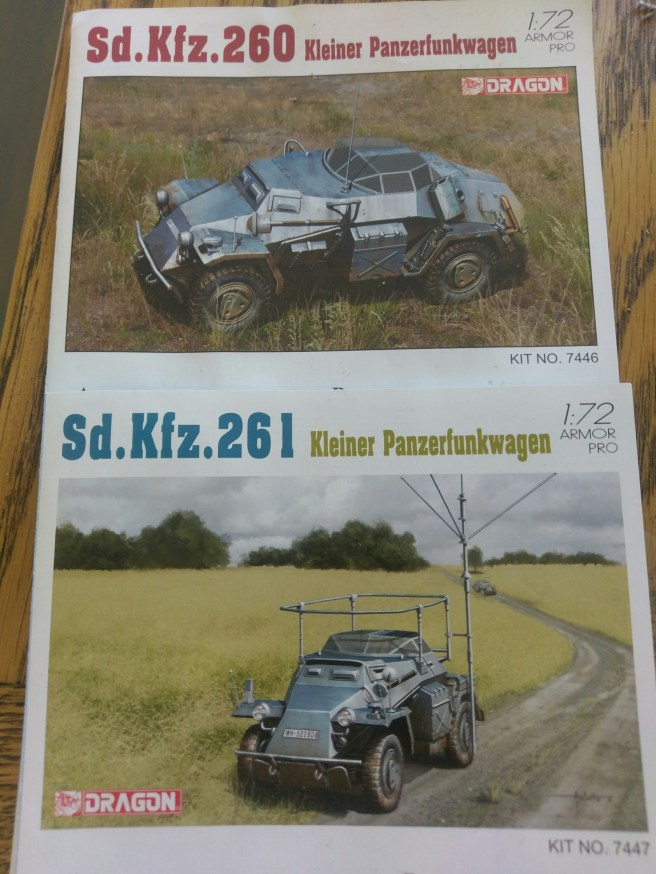
Dragon Models Sd.Kfz 260 and Sd.Kfz 261 Kleiner Panzerfunkwagens

I picked up these two little armoured cars from BNA Model World, who were having a sale a few weeks back. Dragon kits tend to be a bit pricier than others, but can be great to build, so i am always on the look out for a bargain. These guys came in around $15 each including postage and i couldn’t resist.

Armoured cars are a particular favourite of mine to build and for wargaming units they are very handy. I like to use them as command vehicles, forward observers and also to ferry around heavy weapons teams. These two kits will be especially useful as command vehicles and forward observers, as they are both unarmed and so will need to keep a low profile.

Both similar kits the only real difference is the massive aerial the Sd.Kfz 261 has, plus the metal rail above the hull. My wife thought the Sd.Kfz 261 might well  double up as the laundry platoon, as the aerial looks like a hills hoist. So they easily could have dried a few uniforms. Building these two tiny vehicles involves a two part hull, plus a simple axle and suspension set up. That bit is easy. Then it gets quite fiddly as you need to attach plenty of detail, some of it very skinny and fragile, onto the outside of the hull. Some parts need filling and sanding as the same hull mould is used for all the Sd.Kfz versions and holes need to be filled when not used. I managed to break a few parts very easily so i would not recommend these kits if you want a really sturdy wargames model that is going to get thrown around. The only disappointing thing i found was the metal mesh crew hatches or turret should have been photo etched or metal rather than being solid plastic. Also the option to model the roof/turret open would have been a welcome alternative.

Overall a challenging pair of armoured cars and really enjoyable to build. Definitely on the fragile side. I managed to drop the Sd.Kfz 261 on his head just as i finished flocking the base. Luckily he had the instincts of a cat and landed on his feet, i only had to reattach him by the axles and also lost one headlight. Butter fingers. I might have uttered an expletive or two. Photos below.

imag04652

Assault on Camembert June 9th 1944

As the British moved forward from the Normandy beaches they managed to grab some small towns ahead of the main invasion force. One of these small towns is a little known hamlet called Camembert, on the road to Rochefort. A worn down British Company from the 17th Durham Light Infantry had taken the German forces by surprise and were just holding on by the skin of their teeth. Colonel Frank Mustard was occupying the town with two platoons of infantry, a couple of Cromwells and a Firefly as armour, plus a 17 pdr and a battery of 80mm mortars. In reserve he had the lumbering Churchill AVRE which was fresh from blowing up some Normandy beach defences. So not an insignificant force. Colonel Mustard had orders to hold Camembert against a possible German counterattack.

Just down the road through the bocage the counterattack was inevitably coming. A much bigger German force was on the way including one troop of Panthers, a troop of Panzer IVs, a company of Panzer Grenadiers, an 88mm and some Pak40 AT guns, plus a dangerous Tiger in support. So outnumbered and outgunned the British had their work cut out to hold on. The British plan was to try and destroy some German armour on the main roads leading to the village and block them up, then bring in mortar fire to further mess up the forces and pin them down.

It all started so well as the Firefly took out the lead Panther on the West road and blocked it up, while the 17pdr stalled the Tiger rolling down the East road. That was as good as it got for the Brits. The mortars never found their range and basically did nothing allowing the Germans to continue to advance. The remaining three Panthers got through the bocage and made very light work of the Firefly and his Cromwell friends. Then once the Tiger survived three direct hits from the 17pdr it took one big shot from close range to destroy the doomed anti tank gun. By this time the reserve Churchill AVRE has spent 5 moves moving about three inches and was already too late

Suddenly the Panthers and the Tiger were in the village. The Brits had no answers to the big cats and Colonel Mustard threw in the towel. So a decisive German victory i think. Next time the British need to be more alert and get those mortars firing early to have any chance. Plus be a bit smarter with some ambush tactics rather than just exposing themselves to the enemy so easily.

Farmhouse Rural Building

I finally finished my farmhouse for my Normandy terrain. I based this roughly on some of the amazing scenery built by David Wright in his book “Making Rural Buildings For Model Railways”. This book is a must read for anyone looking to build their own scenery. I followed all of the suggestions in it and it improved my little farmhouse no end! I have tried a couple of manufactured buildings from different companies and nothing measures up if you have the time and the energy to scratch build your own structures. Your creations will also be what you want, to your designs, and fit perfectly with your other scenery and models. I think making your own stuff is the most rewarding thing about this hobby!

Using a foam board base for the structure, the key is to give it a coating of glue and modelling clay or ready made filler or plaster. Stonework is then carved into the buildings skin in whatever texture you like. Regular bricks or rural stonework or anything that looks the part. I picked up a $15 electric engraving tool from eBay (China) which speeded up this process a great deal. Hand scribing individual stones is a time consuming effort, but well worth it. Roof tiles were made out of Christmas cards, flashing from aluminium foil. I did buy the chimney pots (another suggestion from David Wright) but everything else is easily found and inexpensive to pick up at the art shop or stationery cupboard.

I was very pleased how this turned out, now i need to finish the rest of my farm, including  a little stable with a corrugated iron roof, an old shed with a hay loft and a big barn. Also need to pick up a vintage tractor from somewhere and make some hay bales. Will probably make a farmyard with walls and find some animals to scale to finish the scene. If you want to make your own buildings for wargames i suggest you check out David’s book as it is all you will ever need! I put the new farmhouse on the edge of my table just so you can get an idea.

HaT Industrie British Mortars in 1/72 scale

I finally got around to painting up some mortar teams for my British Army units for Normandy. These plastic figures are great value as you get 4 complete mortars and a whole bunch of crew, radio operators and officers with binoculars. I think for under $10 a box (i picked mine up from Hannants on line) they will make an excellent mortar battery for your infantry company.

Image result for hat british mortars

It means that you can vary your set up with each mortar and make each base a little different. The detail is not that great, but, in plastic, and for that price you cant do much better. I think other metal manufacturers will do a sharper job but you will pay lots more. The facial detail is particularly lacking and you end up almost painting features on some of them which isn’t ideal. I based my guys on MDF as usual and mixed up the poses to create four different scenes. Another blogger had given me a good tip for using gauze or crepe bandage as camo netting, so i applied some to the helmets of some of my mortar crew. A few highlights and they look pretty good. Also with my new magnifying glass i was able to paint some maps as the spotter checks his coordinates. I also added some boxes and bits and pieces. Happy the way they came out and i always prefer to have my mortars on the board. I used an officer and a radio man as the forward observer. The only thing i may change is the plastic radio aerial which is way too thick.

Below are some photos of my finished teams. Also i based my Revell Tiger tank and did some more weathering and dirt. He is in there somewhere with his buddy the Zvezda Tiger.


Painting Light and Magnifying Glass

I had a whine about my poor old eyes being old and grey and my arms being knackered and broken and a fellow blogger chimed in with a recommendation to purchase one of these. It’s an awesome magnifying glass with a bendy arm and clamp, plus a built in bright LED light. The days of going cross eyed trying to paint tiny dots on tiny men in semi darkness are now a thing of the past. Well they are a thing of 2016. Now in 2017 i can paint even smaller dots of camouflage and even put dots inside the dots. I can even paint tiny maps and tiny ordnance survey symbols on the tiny map. Well maybe not but still it’s a huge improvement. Anyone out there who is struggling with this stuff please go and get one. My lovely wife purchased one for me for Christmas. Woo hoo. Also thanks to my blogger modeller friend for a great suggestion. It even has a small section that is double the magnification. It takes a while to get used to the distance your hand is from the model under the lens. Bit of practice is all you need. I don’t know how i managed before i had this.