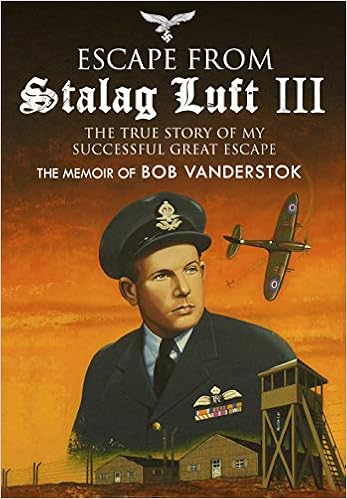
Escape From Stalag Luft III

One of my favourite movies of all time must be the Great Escape. Watching Steve McQueen try and hurdle the barbed wire on his German motor bike, and losing my mind when Gordon Jackson gets caught out at the train station with the simple words “Good Luck”. It is one of the greatest War movies of all time, capturing the spirit of Allied POWS trying to continue the war effort, and their never say die initiative and ingenuity. Its a classic, although its roots are firmly entrenched in the horror and suffering of war.

When you read Bob Vanderstok’s book about the escape you can see how the movie captures the actual events and personalities involved so well. As a Dutch pilot Vanderstok actually had to first of all escape Holland and make his way to England where as a RAF pilot he was then shot down, captured and sent to Stalag Luft III. So in reality he escaped twice. The book is a riveting read from start to finish. The lengths the prisoners went to, from unsuccessful escapes, to planning and resourcing via any means necessary, are just amazing. The escape was a fantastic achievement and a great climax to the book, although obviously tainted with great sadness as many of the escapees were captured and killed.

If you love the movie you will love the book, so I suggest you buy a copy! If you haven’t watched the classic The Great Escape you need to sort that out too quicksmart!

Esci Pz.Kpfw.V Panther in 1/72 scale

One more Panther! This will be it. I now have seven Panthers which is enough for any battle. Four from PSC, Zvezda, Dragon and now a vintage Esci kit.

I have been having a lot of fun buying up these old Esci kits on eBay. They really hold up well even after all these years. I think I like the smell of old cardboard and instructions with brown edges. This one had an illustration of using a lit cigarette to help melt a bit of sprue for an aerial. Fantastic suggestion back when cigarettes were good for you.

In comparison the other Panthers I have built in this scale, it measures up well. It is a nice chunky model, like the Plastic Soldier Company ones, only with much better detail. I also prefer it to the Dragon Panther which is too refined and looks a bit boring. So it was a winner all round. I did not use the crewman as he was rubbish, and may pop a nice AB figures German officer in the hatch. I was very happy with the end result, but the building of this model kit was definitely a challenge. Two words. Vinyl tracks. I am sort of seeing them as a positive now, like a badge of courage, I have to conquer the shitty vinyl tracks. In this case I managed to snap the front sprockets, but trusty drill and wire to the rescue I fixed them up better than ever. Probably two gallons of super glue were used in the making of this cat.

A very weird design issue with this kit was the lack of hull above the running gear. Esci have left off a whole area where you can just see into the hull of the tank. Very odd. So that needed fixing with some thin plastic card. The tow cables were tricky to fit and needed more super glue and patience. I made an aerial out of washing up brush as usual, rather than taking up smoking again and stretching sprue with my Benson and Hedges.

I gave up modelling when I started smoking in the 1980’s, but then luckily modelling has been the addictive habit I have taken up again in the 2010’s. Gave up smoking a long time ago. Probably a good swap from a health perspective.

I used a red brown base followed by dark sand and three colour camo. I made sure I under cooked the chipping and went easy on the dust and dirt. Learning from previous over cooking. The original decals were brown and crispy like barbequed pork so I used some nice new ones. Happy Easter everyone!

8026


Esci Jagdtiger in 1/72 scale

Oh boy another big cat I had never built before. This time a Jagdtiger tank destroyer. It’s a beast of a vehicle. Another eBay purchase for not much more than pennies. The kit seemed pretty old as the box was beaten up and the decals died a while back, but the box art still looks pretty good. Opening up the kit I just love the smell of 1980’s childhood I get from fading paper instructions and old cardboard.

I do read a lot of criticism on the net about these old Esci kits, but I love them. This one is another old gem. It’s a relatively straight forward and easy build as the tank has no turret and is made up up a big piece of lower hull and a big piece of upper hull. One massive barrel of a gun. It comes with a commander figure who I declined to include, plus a couple of hatch torsos who were also relegated to the spares box. All the detail is nice and chunky. Towing cable and extra track add some interest to the solid sides of the tank. One of the pictures in the instructions showed some battle damage on one side of the fender, so I hacked off the front fender on the left side.

The only thing that’s a real struggle with these Esci kits are the tracks. They are this horrible stiff vinyl type stuff that doesn’t want to go where you want it to go. Whatever you do, do not attach the side fenders until after you have the tracks finished. I used a lot of super glue and some clamps and wedges, and a lot of patience to get the tracks to glue and stay. I found that gluing and weighting or clamping or wedging them a small section at a time was the only way to do it. I managed to get the tracks to wrap around the front sprocket and then sag only by wedging some card firmly under the upper hull while the super glue was drying. So tracks aside the construction was problem free!

Paint job was a three colour camouflage I pinched from the internet somewhere. Chipping and mud and dust and rust all added later. The decals are from my spares box as the originals were yellow and crispy. Overall a great little old kit that still scrubs up nicely, if you can put up with the tracks from hell……….

My photos are limited to the churchyard right now as everything is packed away ready for some renovations in our house!

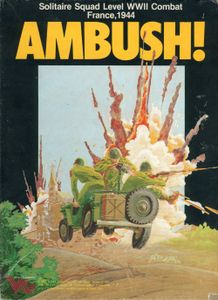
Ambush! by Victory Games

Slight change of pace for Colonel M this post. I have been itching to play this board game for a while since I bought an old copy on eBay. I always thought it was going to be exactly the kind of game that I would enjoy and I was not disappointed. All of my wargaming time is spent flying solo so it is a special treat to have a game dedicated to the solo gamer. Painting and modelling has been put on the back burner for a couple of weeks as I have played through the first couple of missions of “Ambush”.

Image result for ambush by victory games

Although out of print you can still pick up a copy for $100 or maybe better if you have a good hunt around. It’s an engrossing, exciting and challenging game. You create a squad of US troops, then sneak them around a map. There is a very clever system of hex lookups which can point you to an event, depending on where you are on the map and what has already happened. So you never know what is around the corner. It could be a German sniper in the trees or an LMG on your flank. Your reaction and perception levels all affect how quickly you may see something. If your squad is a bit slow and wander into the wrong hex it could be all over. Of course once you have played a mission once, and probably failed hopelessly the first time, the following attempts do get easier as some of the surprises you will have already encountered. My first mission I was far too bold and half my squad was wiped out very quickly. The difficulty of the game does encourage some replay potential.

While nothing is happening and no Germans have appeared, gameplay is very quick as you move from hex to hex. Once someone appears trying to waste your squad gameplay changes into an excellent combat process. Initiative is crucial, as are your commanders. Your officers can give other soldiers extra actions and also prevent panic, so don’t spread your men out too thinly or the weaker ones may fall in a heap in the dirt. But also don’t bunch up too close or that MG42 will cut you to pieces.

Its addictive. Once you start a mission its like a good book you cannot put down. Just one more hex. I just want to see if I can cross that road. There are periods when all you can hear are your squads boots stepping cautiously along the track. Then without warning bullets ring out and your men are hitting the dirt. Its a lot of a fun, so painting and modelling might be in second place for a couple of weeks yet. I am already thinking that some of these rules could be adapted for my table top games as they are so much fun to play.


“Objective Falaise” by George Bernage

falaise

Another excellent publication from my friends at Pen and Sword. I have read a couple of books before by Mr Bernage and they are always very interesting.

“Objective Falaise” is jam packed with maps, photos and first hand stories from a couple of Allied offensives after the Normandy invasion. They revolve around the attempt by the Allies to surround the Germans near Caen in the Falaise Pocket. As an avid wargamer the book gives plenty of scope to adapt many of the stories and situations into a scenario for the table top. For someone interested in World War Two military history its also a very well written and invaluable resource for an important post D-Day confrontation.

The maps and photos are particularly good, some of them copies of original combat maps, from larger scale maps of the terrain down to more small scale maps with individual tanks marked. The photos also show some “then and now” type comparisons. Also very cool photos of actual wrecks in situ and even bits of tanks that a farmer salvaged and kept on his farm.

My favourite part of the book is the story behind the demise of the famous Tiger Tank commander Michael Wittman. It gives a full run down of his last fight and images and maps of how the situation unfolded. Excellent stuff. This part will definitely be used by me in a table top scenario some time in the future.

My only real criticism, which is common for this kind of book, is the lack of one main map with a step by step chronological guide that links all the text and stories together. Without this type of easy to follow reference I did get a bit lost in the story and how each day progressed. Too many small maps that were hard to read in relation to the overall tactics and movement. So I did get a bit lost from a geographic perspective. Overall its a good read and very useful and interesting for historians and wargamers alike.


AB Figures British Infantry on patrol

Happy Christmas everyone from down here in sunny Australia. A Boxing Day post while watching the cricket, who could wish for a better day! I am feverishly trying to finish off my company of British infantry so I can replace all my plastic figures, which I am not so keen on, with far better metal ones.

Here are another ten British infantry from my favourite AB Figures. I actually picked these up in an eBay bundle of all sorts of metal figures. It turned out to be a total treasure trove of figures from a lady in the UK who labelled them Anthony Barton figures and I think the naming bypassed all the other modellers like me who would have jumped all over them. The cache also included some Stonewall Figures which i had never heard of, and will be detailed in my next blog or so.

These AB Figures are a squad of ten, including one sterling MG and one Bren gunner, who will be my CO and NCO respectively. They are all in marching, patrolling stances with guns slung over shoulders or carried. As usual with AB the poses are natural and look great, plus the sculpting and detail is second to none. These guys really do paint themselves. The faces are so good that one wash of a red brown over base flesh pretty much looks good enough. Unfortunately my phone camera and photo skills really do not do them justice. Although the faded background does make the photos look like a hazy sunrise patrol. Taking photos of small soldiers really does require extra light and a good camera. Neither of which I have.

I tend to repeat myself a bit, but AB Figures really are the top shelf of wargaming figures, if you did not get any for Christmas, make sure you go out and grab some for a New Year’s present to yourself! Check them out at AB Figures

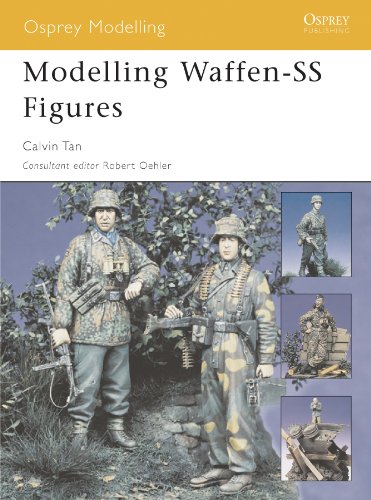
Modelling Waffen SS Figures by Osprey Publishing

I picked up this excellent book from the Book Depository for less than $20. I am currently working on stack of figures for my German forces from CP Models and AB Figures and needed some more inspiration for my camouflage uniforms.

Although aimed at the 1/35 scale figure modeler there is still a lot to like for the smaller scale hobbyist like me. And probably you too if you are reading this. The author details three or four different German SS figures and his process of building, converting, adding and finally painting. What he does with converting some of the figures and the detailing them with extras of his own is quite amazing. There are definitely tips and tricks to be learnt for the 1/72 scale figure modeler and painter from this book.

I was most interested in his guides for painting camouflage schemes. He does a great Oak Leaf, Plane Tree, Pea Dot and Italian camo on various 1/35 scale figures. It gives you an excellent guide to what colours to use and what patterns to apply. I will be trying this out on my pile of little guys soon when I get the chance. This book is a nice quick read but definitely worth adding to your library, especially if you are keen to keep perfecting those camo schemes.

I have been up to my neck building more German armour and have not managed to finish anything so posts have been a bit scarce this month! A Stug III and a Stug IV should be at the finishing line soon!

Image result for osprey modelling waffen SS

Normandy Church scratch build in 1/72 scale

I have been busy working on my final building for my Normandy village. After hunting around everywhere looking at purchasing a church for my village it was decided that the only way to go was to build my own. So here is L’Eglise de Moutarde Forte in all its glory. I made the structure out of 3mm foam board glued together with PVA. If you use dressmaking pins to keep it all together while the glue dries that will help.

Once you have built the shell with all the window and door apertures cut out, I gave it good thick coating of plaster. I use the ready made stuff from Bunnings and just slap it on with my hands. A good sanding down with sandpaper and then I laboriously carve the brickwork using my Chinese etching tool ($10 on ebay and a few batteries later…) It helps to leave the structure apart for this stage otherwise its hard to carve your stonework into the corners. This part was very time consuming and probably took me a week or more doing some scribing every day. Tedious. But worth it. I added some buttresses for extra detail. These were foam board coated and carved as before.

Now my one problem area was the windows. Making nice arches with delicate window settings was close to impossible. After a lot of research I found a company in the USA that does exactly the right thing in exactly the right size for my project. Rusty Stumps make all sorts of modelling goodies, I think aimed at model railway people more than wargamers, but still will give you many great options for building your own stuff! Walt, who runs the place was super helpful and even posted my chosen windows to an address in the states, as we happened to be there on holiday. I bought two sheets of windows, some thicker, some thinner, and used all of them in my church. They are super thin MDF and very delicate. So I was very careful in gluing them and their accompanying frames behind the apertures I had cut, after I had scribed all my bricks. Once they were glued in securely I went around and filled any small gaps with extra plaster. The Rusty Stump windows also come with thin plastic windows to glue behind the frames if you like. I didn’t bother as I was happy enough with the effect.

The spire roof, main roof and smaller front roof are all removable. Made out of thick card on foam board supports. Then its old Christmas cards recycled to make slates glued in strips. Again, another time consuming process, but worth the effort.

The whole thing was base coated in grey primer. Just make sure you have given any foam board edges a coat of PVA glue otherwise you may find spray paint dissolving stuff. I used various light brown, light grey, yellows and ochres for the stone work, and paynes grey in various shades for the roof. The roof was also given small stippled patches of yellow ochre and pale green for mossy bits, plus some weathering powders streaked in brown and earth.

Now he is finished and I can actually get on and set up my whole village ready for battle.

More AB Figures British Infantry in 1/72 scale

Some more finished British Infantry for my Northumbrian division. It takes me so long to paint the little fellas, I have to write myself a step by step list to work through slowly. So this group of fifteen good men must have taken me two weeks to finish off.

First off is a group of six from my ever expanding AB figures range. These are my favourite to paint, the detail and sculpting makes it easier at this scale. I particularly like the officer, his sten gun thrown over his shoulder, pulling a pin out of a pineapple grenade. Great stuff.  Next up are four guys from CP Models in the UK. Another great figure maker and also nice and clear to paint. One soldier is carrying a fuel can and another has pinched a panzerfaust from somewhere. I have a few more excellent British from CP which will be in my next painting batch.

The other figures are from SHQ Miniatures and a company i can’t remember the name of. SHQ are a bit smaller, but still fit fine with everyone else. Their faces are brilliant, but the rest of the figure does not quite match AB and CP. Still nice figures and good for padding out your platoons with some other poses. The figure that I cannot remember where i got him from does not measure up to the others standards. So you don’t need to worry about that then!

If you are looking for metal figures in 1/72 scale then AB Figures (i get mine from Eureka Miniatures in Melbourne) and CP models in the UK, are the best for you!

“Churchill Tanks” by Dennis Oliver

Another excellent publication from Pen And Sword’s Tank Craft series arrived for me before Christmas and it has taken me a while to sit down properly and give it my full attention.

The Churchill tank is another iconic armoured vehicle from World War Two. Its unique boxy shape and tracks make it one of the more unusual looking tanks from the war. It was also developed into various different engineering models,  including a bridge layer and flamethrower version.

Dennis Oliver covers every aspect of the Churchill in great detail and this is a good book for anyone with a historical, modelling or wargaming interest in the tank. He goes through the use of the vehicle in all of its units at the back end of the war. I particularly like the details on individual tank names that were used and that’s something I plan to adopt when i am building my next Churchills. The historical details are accompanied by numerous excellent illustrations and photographs, more great inspiration for whatever you want to do.

There is also a comprehensive guide to the various choices modellers have to build their own Churchill kit in most scales. This is aimed more at 1/35 scale modellers but inspiring none the less for everyone. There are more great pictures of completed kits by highly skilful modellers. I love reading about and looking at tanks, so if you are like me you will like this book!

IMAG1363