Tiger Terrain Country Walls

A very quick update on the other walls I bought from Tiger Terrain

You can buy this set to complete a walled paddock, including an open gate. I just glued them onto some MDF and added fine sand. Then just flocked and static grassed everything. I used the excellent rubbing a balloon trick to get the static grass to stand up once I had sprinkled it onto diluted PVA glue. I have all the eBay bits to make my own static grass applicator but have not got around to it quite yet.

The walls are great, very finely cast with great detail. I will be getting more of these for sure from Stephan at Tiger Terrain. I am hoping he expands his 20mm range to do some more stuff. I still have a small ruined cottage to paint from him, but it would be good to see some more buildings in this scale.

Stone walls from Tiger Terrain

To complete my Normandy Church I needed to make a base with some nice stone walls. Looking around I wanted to try a new source for my church yard rather than making them myself.  Tiger Terrain make some great looking buildings and scenery in 15mm/20mm scale and I decided to grab some of their rustic stone walls plus some tidier brick walls with stone capping and some entrance pillars.

Their buildings look great, and they have a nice looking range in 15mm plus a few in 20mm. I grabbed a small cottage in 20mm just to try them out. I think if i had my time over I would have made all my buildings with a smaller footprint so I could have used some of these excellent 15mm houses too. They look great.

My church base was cut from MDF and the stone walls glued straight on with PVA according to my plan of two gateways and just an open section. The walls are beautifully cast with no bubbles or defects and they fit together nicely. The detail is great. I threw a whole load of fine sand over PVA to give the base some texture. I then built up the pathways with more sand. Green flock followed by two shades of static grass finished things off. I used the balloon rubbing trick to get the static grass to wake up a bit. I am planning a home made static grass applicator but that will be another story sometime….

I was happy with the end result. My church can be a country church or you can take it off the base and just have in the middle of town instead. I wanted it to be an angle just to add some interest and make it a bit less asymmetrical…… in case you are wondering. My wife did.

Normandy Church scratch build in 1/72 scale

I have been busy working on my final building for my Normandy village. After hunting around everywhere looking at purchasing a church for my village it was decided that the only way to go was to build my own. So here is L’Eglise de Moutarde Forte in all its glory. I made the structure out of 3mm foam board glued together with PVA. If you use dressmaking pins to keep it all together while the glue dries that will help.

Once you have built the shell with all the window and door apertures cut out, I gave it good thick coating of plaster. I use the ready made stuff from Bunnings and just slap it on with my hands. A good sanding down with sandpaper and then I laboriously carve the brickwork using my Chinese etching tool ($10 on ebay and a few batteries later…) It helps to leave the structure apart for this stage otherwise its hard to carve your stonework into the corners. This part was very time consuming and probably took me a week or more doing some scribing every day. Tedious. But worth it. I added some buttresses for extra detail. These were foam board coated and carved as before.

Now my one problem area was the windows. Making nice arches with delicate window settings was close to impossible. After a lot of research I found a company in the USA that does exactly the right thing in exactly the right size for my project. Rusty Stumps make all sorts of modelling goodies, I think aimed at model railway people more than wargamers, but still will give you many great options for building your own stuff! Walt, who runs the place was super helpful and even posted my chosen windows to an address in the states, as we happened to be there on holiday. I bought two sheets of windows, some thicker, some thinner, and used all of them in my church. They are super thin MDF and very delicate. So I was very careful in gluing them and their accompanying frames behind the apertures I had cut, after I had scribed all my bricks. Once they were glued in securely I went around and filled any small gaps with extra plaster. The Rusty Stump windows also come with thin plastic windows to glue behind the frames if you like. I didn’t bother as I was happy enough with the effect.

The spire roof, main roof and smaller front roof are all removable. Made out of thick card on foam board supports. Then its old Christmas cards recycled to make slates glued in strips. Again, another time consuming process, but worth the effort.

The whole thing was base coated in grey primer. Just make sure you have given any foam board edges a coat of PVA glue otherwise you may find spray paint dissolving stuff. I used various light brown, light grey, yellows and ochres for the stone work, and paynes grey in various shades for the roof. The roof was also given small stippled patches of yellow ochre and pale green for mossy bits, plus some weathering powders streaked in brown and earth.

Now he is finished and I can actually get on and set up my whole village ready for battle.

Extra Foliage Branches Camouflage for tanks

I wanted to create some extra foliage branches to cover up my German armour. It was a common practice where tank crews would cut branches and drape them and tie them onto their armoured vehicles. Using small bits of lichen I just dipped them into some PVA and then flocked using various different greens. A spray with some varnish kept the whole thing together. Rather than glue these onto my vehicle (in this case my latest Jagdpanzer) I just rested them on there so I can choose to camo up or not! I think they came out quite well and will definitely keep the assault gun under cover behind some tasty bocage. I made plenty of these extra foliage branches so I can use them on whole units. My troop of Panzer IVs were just completed and will be blogged next up with and without extra camo.

“Setting The Scene” by Pat Smith

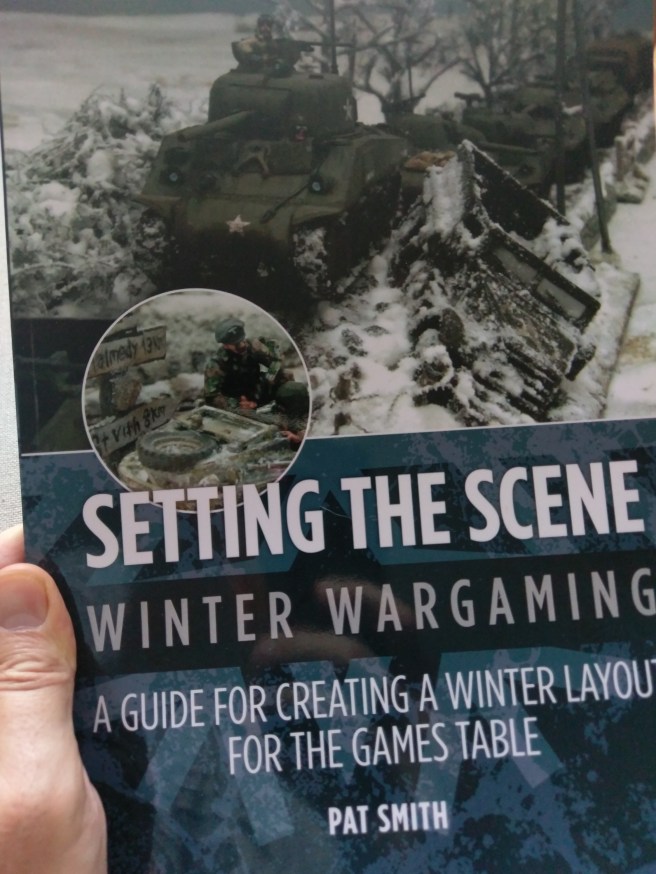
I was lucky enough to order a copy of Pat Smith’s awesome book “Setting The Scene” before Christmas and it turned up on my doorstep recently. What a happy way to start the New Year!

Now I have always been a big fan of Pat’s amazing 28mm modelling on his Wargaming With A Silver Whistle blog and this new production just continues on Pat’s excellent work. I am not a 28mm modeller and was not planning to do any Winter games or scenes right now, but none of that matters. There are so many good ideas and tips and inspirational photos this book is not to be missed if you are a keen wargamer and modeller who likes to build stuff. This is relevant to whatever scale or period you are interested in, but I guess even more so if you are cemented in World War Two like me.

Pat covers many aspects of terrain building from creating a mat, making trees, rivers, bridges and also tips on painting vehicles and figures. So much eye candy and amazing photos of his stunning results I cannot help but keep flicking through the pages. If you are looking for some inspiration and a standard of terrain to aspire to then I suggest you sign up for the reprint which I am guessing will get a run. Drop Pat a note on his blog and get your copy!

Setting The Scene

Walls Walls Walls

After building my Loic Neveu terrain bits and pieces I found I still had some of his low country walls. So striking with my hot iron I quickly glued them all down to a piece of 3mm MDF to make a rough two field kind of configuration. Then a layer of PVA and fine sand, plus some rougher sand nearer the ends of the walls.

I wanted some random scrubland so used a few different types of grass, flock and tufts to cover the field areas. The walls were undercoated black and then highlighted. In retrospect I should have used more browns for the stonework as it came out a bit too black and white. I may change it. These are quite small walls and I realise I should have put a 20mm soldier in here to give you an idea of scale. But these will definitely get some usage in my next games.


More Wrecked Vehicle Terrain Bits

More terrain bits from Loic Neveu that i have finally painted up. I mounted them on MDF first as they are quite delicate around the edges. They are nicely detailed and paint up well with out too much trouble. I used plenty of weathering powder to create a dirty, rusty look. Not much else to add. They fit well into my 1/72 scale stuff and will provide extra cover in my war torn urban situations. You could also use them as objective markers too. Loic has a bucket of interesting stuff on his web site https://neveu.blog4ever.com/articles

Just a quick blog as the photos are self explanatory!

Fences and Rubble Piles

Happy Christmas and New Year everyone! I finished off a couple of terrain bits in between stuffing my face with Christmas goodies. No models in my stocking or models in stockings for that matter. But still expecting some more goodies to show up from various model shops across the globe independent of Father Christmas’s delivery schedule!

Anyway i had some rubble piles and cars from Loic Neveu in France that i had left aside for ages and decided to paint them up. They came out very nicely and fit next to my ruined buildings for extra effect. I have a couple more to finish. I had bought a manor house from Loic too but it is more like 15mm scale and it didn’t fit in with my buildings. If anyone wants the building i bought for 15mm games drop me a note and i will send it to you or at least show you a picture first.

Also there is some fencing i bought from Hovels in the UK. Super cheap at 75p a section and they came out really nicely. At that price i really cant be bothered to make my own which will be no better. Based on MDF and flocked etc. It does make me feel lazy but sometimes buying terrain is just a nice, speedy alternative!

Sarissa Precision Ruined Houses

In my mission to speed up my village building and supplement my very slow scratch building process, i could not resist buying some more MDF kits. This time from Sarissa at http://www.sarissa-precision.com

I have seen lots of pictures and reviews of the Sarissa French Chateau in 20mm and 28mm scale and I was unable to resist the lure of  purchase. So I figured I better make it worthwhile by buying a couple of their 20mm ruined houses at the same time. The Chateau build is for another time, as I decided to get cracking on the ruins first. The kits come flat packed in two sheets of 3mm MDF with a further sheet of window and door fittings in card. At less than $15 Australian a pop they are pretty good value. The best thing is Sarissa does the postage from the UK to Australia at two pounds fifty which is amazing. Definitely makes me want to buy more!

The parts pop out of their sheets easily and consist of a floor or two, walls and roof sections. The roof sections have a triangular support that gives the structure some strength. So all you need is some PVA glue and bobs your uncle. Once you have the structure made you can add the windows and shutters, door frames and doors. You do need to think ahead about what you are going to paint before you finish building as it might be tricky to paint some bits after full construction.

Now i really like these kits but did need to add some of my own bits and pieces just to get them up to speed. Firstly its very obvious where the MDF corners are, so i used my gyprock plaster to give my buildings a texture, before i added the details. This covered up the joins and created a more interesting surface. I also could not quite understand the chimney construction, maybe i did it wrong, so i also had to add some MDF to line everything up. The chimney pots i cut off and replaced with some excellent metal ones i had bought from a model shop, which i think was a good improvement. I also added my own cardboard roof tiles onto the roof remains which give more texture to the roof than the original flat MDF. I also added textured bricks carved into the plaster along the bottom of the walls and also bits of rubble and debris inside the damaged walls. It was a lot of fun to customize these little buildings, but i think they would come out nicely whether you choose to do this or not.

Painting took me a while and i just used basic acrylics. I added a couple of French signs to the sides and then added some black and brown chalk dust to the damaged bits to give the finished result a burnt out look. I am looking forward to building the Chateau now after these two. If  you need some quick and easy buildings with a lot of scope to customize then go and check out Sarissa. You can see below how well they fit in with one of my home made buildings – the blue two storey house with a big blown in the middle of it…..


Cobbled Streets and Town Square

I am never been satisfied with my cobbled streets made out of purchased, patterned card and stuck onto MDF. They still look flat and a bit unrealistic. But I refuse to pay any big money for roads when they should be easy to make. So I cut out the usual shapes and strips of 3mm MDF and gave them a 1-2mm coating of ready mixed plaster. I get a big tub of Gyprock Topcoat from Bunnings which will last for ever. Its great for doing texture on buildings too. Make sure the coating is pretty smooth, although it doesn’t need to be a perfect finish, and leave it to dry overnight.

Then comes the entertaining bit…… First of all I draw horizontal guide lines every 5mm across of all the pieces you want to do. Although you can make the distance smaller or wider depending on how big you want to make your cobbles. I invested in a $10 etching tool on eBay from China. What a great machine. It runs on AAA batteries and its shaped like a big pen so you can sit and carve bricks and cobbles all day long. And it does take all day long. Its much easier and quicker than trying to carve with an old scalpel or blade. Jump on eBay and grab one. It still took me ages to engrave a town square, a couple of roads and another little square. Once the cobbles are carved its just a question of painting them grey and throwing some brown and black washes over them. I did add some brown, black and sand coloured chalk powder on them too. Dirty them up a bit.

You can see in the first picture the effect of the cobbled square and street. Also as a comparison I put my old card cobbled square and streets next to them so you can see the difference. It was a good opportunity to get out all my houses and put them together. Here is a mixture of home made, laser cut MDF and cardboard kits. I think they all mix in together quite nicely, and no two houses are ever identical.

Must get cracking on my village church…….