More Panther Tanks from The Plastic Soldier Company

I built and painted the other two Panther tanks i had in my warehouse from The Plastic Soldier Company. Great little models, they go together in around 15 minutes. Nice detail and very solid kits. This time i used one of the commander figures they supply and he came up really well. I did some light pink braiding on his uniform which adds a bit of colour. I tried out some new camouflage schemes, one a straight olive green and the other a three colour scheme. Camouflage schemes for reference are abundant on the net, and i usually find a nice one as a starting point. Once you get painting its pretty easy to continue the pattern across the whole vehicle. I used some decals from my spares plus some Sergeants Mess spare track and spare wheel just to add some variety.

Photos of the two cats below! Only a quick blog as i have written about these guys before.

Ruined Buildings Part 3

So finally after all that construction it’s on to the paint job! Everything was painted a black acrylic as a base coat or primer. That gives the whole thing a good starting point and makes sure all the shadows are emphasized. I painted the undamaged rendered walls first, one a sand colour and one a pale blue. The insides were all painted a dark grey as more than likely they would have burnt in the fires/explosions that must have occurred. Previously i have used wrapping paper with a very small pattern on it as wallpaper. You could easily find a pattern on line and then print it out to a small scale to use as wallpaper for some of the internal walls.

The rubble and debris was also painted dark grey and then dry brushed with lighter shades to a very light grey. The exposed brick was painted a mix of bright red and a terracotta red. I also painted random bits of debris with the same red as many bricks would have fallen around the house. To illustrate the mortar i used a fine brush and a light grey to draw thin lines in between the detail on the exposed brick. The bits of wood on the floor, the roof beams and the internal floors were all painted a dark brown. I left plenty of black on the roof beams to suggest the charred nature of the remains. All the window lintels and shutters were painted white, and needed a couple of coats to get them right. I just used a black biro to draw on the shutters, much easier than a paint brush.

The roof tiles were painted grey and then randomly painted with lighter greys to mix them up a bit. I left plenty of black areas near to blast holes. Finally i lightly brushed black around all the damaged bits to show the extra effects of smoke. To add that extra bit of detail i found some cool French signs on the internet, printed them out and stuck them on the buildings with a lot of PVA glue so they look painted on. A bit of green flock on the base and hey presto the finished ruins.

See my photos below including some British units just nosing around in the smoky ruins! Over and out Colonel Mustard.


Ruined Buildings Part 2

I have continued working on my ruined buildings, and have decided to split the process into three blogs as otherwise it would be a bit heavy on the pictures. However, I did want to detail each part of the construction, so here goes!

To create the piles of debris inside and outside the ruins i first glued lumps of modelling clay at positions on the base next to the walls. I did this both on the interior and exterior in a random way, still leaving decent areas of the interior floor bare. I then covered these raised areas in PVA glue and sprinkled a decent amount of dirt/gravel from my front pathway on top. The stuff out the front of our house is perfect for producing random debris. You can see the construction taking shape below.

Next up i need to add a texture or render effect on the walls to get rid of the smooth finish of the foam board. I do this by mixing a fine sand (pinched from the play ground around the corner) with a paint thickening medium i found in my art box. You could do the same with sand and PVA glue mixed up. I then paint a liberal layer of the stuff onto all the exposed walls, making sure to stay away from the exposed brickwork and the window frames, and let it dry. This makes an excellent texture to paint on the outside of the houses.

To add a bit more character i needed to make more rubble and debris for around the place. The rubble i made with more modelling clay by rolling out a large flat piece to about 1-2mm thick and when it was half dry cut it into small cubes. I made a big pile of bricks and rubble this way. I also chopped up bits of balsa wood into broken beams and bits of roof. This extra debris was then glued on top of the original piles, and new small piles were also added just using the new rubble.

The whole building was then painted with black acrylic. Be careful not to use a cheap spray paint on foamboard as it can dissolve the inner foam part, and therefore would destroy all your hard work carving the brickwork. Last but not least i made a framework for the roof sections out of balsa wood and roof tiles out of more modelling clay. The damaged removable first floor sections were also made with balsa wood. I just drew floorboards onto the balsa wood using a biro which creates a decent paintable effect. So now all the bits are made all that is if left is to paint and construct. We will see the end result in Part 3!

20160430_074755


Ruined Buildings Part 1

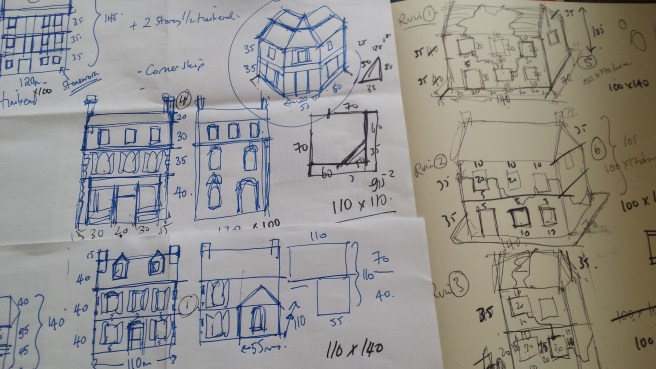
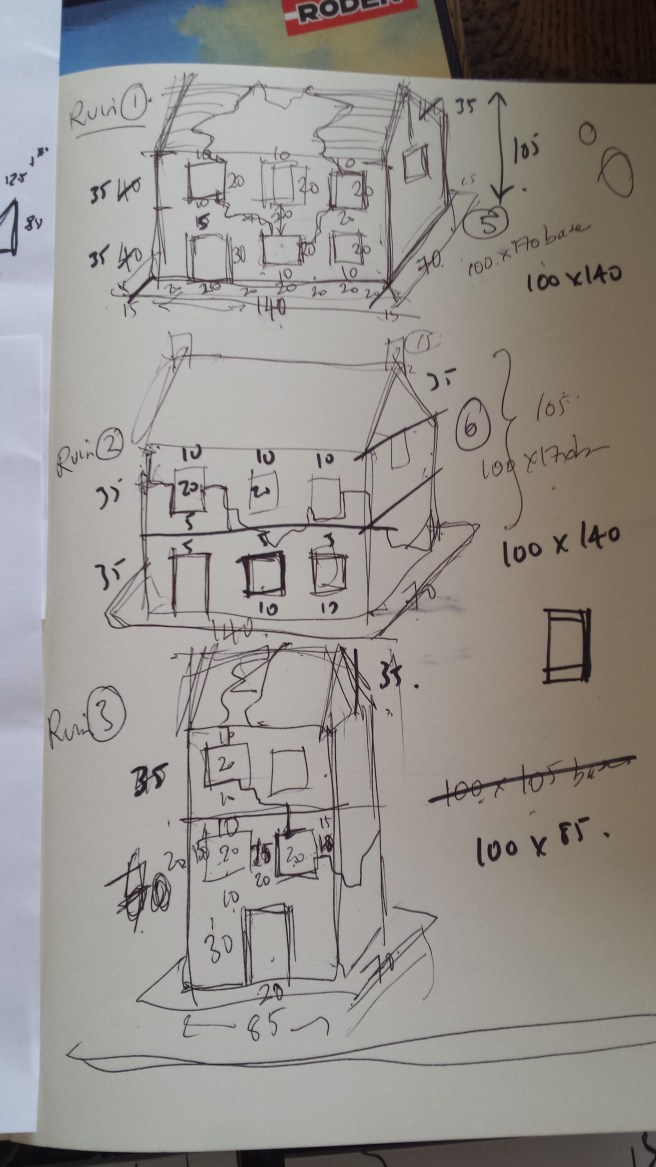
I wanted to make some more ruined and battle damaged buildings for my table top, and thought i would document the process with the help of Colonel Mustard.

First up i drew up some rough plans and designs. There are plenty of places to get inspiration, the internet being the most obvious. I settled on making a house that has its centre completely blown out and a half flattened, heavily damaged cottage. I use 40mm per storey as my basic measurement (although in my drawings i did change to 35mm but then changed my mind back). Doors are 15mm x 30mm tall and windows 20mm square. I sketch out the basic plan and measurements as you can see below.
20160422_12370720160422_123841

For the base i use a 15mm border around the bottom of the building. In this case i only put a border around the front and back as i wanted to be able to place the ruins adjacent to each other with no gap to form a ruined terrace. My next step is to cut bases out of 3mm MDF, making sure you calculate the correct width and length of your building plus any border required. I then draw my building design onto 5mm foamboard. Most houses end up as four pieces as they are no more complicated than a box. I guess this is why i object to paying through the nose for purchased buildings as they are little more than an MDF or plastic or resin box that is decorated! I can do that for less than $30 per house.

Once you have accurately drawn your building cut it out carefully using a sharp knife. Try and keep the knife perpendicular so you cut straight through the foam and don’t leave any wonky angles. Cut out all the window and door frames too.

20160422_123751

I then cut away some of the card covering on the foamboard where the building render has been damaged. You can draw guidelines around some of the damaged walls and then cut through the card outer layer. Slide your knife under the card layer and peel if off carefully. Then with a ballpoint pen draw on exposed brickwork. When you press on the foam core it creates a texture which looks really good. Then its glue your box together on the base  with PVA glue and leave to dry.

Then its a question of cutting out 20mm x 5mm sections of balsa wood and gluing them into the windows as frames. i also add 20mm x 5mm balsa wood as window mantels and lintels. Above the doors i also put a 15mm x 5mm lintel. On the inside walls i add balsa wood beams halfway up the building, which indicate where the floor would have been, or if you do put some floor in they can act as supports.

At this stage our ruins look like this. In my next post we will do the building texture, rubble and debris, the roof and finally painting!


Normandy Bocage Part 2

Following on from my blog a few weeks ago i recently finished more bocage sections using the same techniques as before. MDF bases with coconut fibre foliage flocked heavily with a bright green. Some sections include trees sticking out, which is apparently how these hedges evolved. Some sources put bocage up to 5m in height so with a scale of 10mm to 1m I made these sections up to 50mm tall. They definitely look the part and will block line of sight nicely and make my Normandy battlefields look more and more realistic.

I laid them all out with a home made ruined building and a few German armoured vehicles cruising through. Check out my photos below!

Hasegawa Sd.Kfz 251/1 Ausf. D Halftrack

Panzergrenadiers always need more half tracks to get them around the battlefield. In 1/72 scale there are plenty of options to choose from. After trying the Plastic Soldier Company fast build half track kits i wanted something that gave me a bit more of a challenge in the modelling department. The result was the purchase of a couple of these Sd/Kfz 251’s from Hasegawa at around AUD $10 each from my favourite Japanese hobby shop. In my experience Hasegawa kits are nice models, and provide a good mix of decent detail and an interesting build. This one is no exception.

You build the running gear first with all the individual wheels and rubber tracks. I have read plenty of complaints about these tracks but i think they are fine once you paint them. The running gear is then attached to the lower hull. I kept the upper hull unattached until after painting so i could paint the interior easily. No driver is supplied so i cut down a Plastic Soldier Company passenger i had spare and fitted him in. He lost most of his legs to squeeze in, but you can barely see the back of his head anyway. I also had some spare stowage and jerry cans (one of which i realise i put on backwards oops) which went on the armoured sides of the vehicle.

Paint job was the usual Tamiya Dark Yellow Dunkelb and a hand painted dark green camouflage scheme. Good decals are provided with a whole selection of numbers. You can never have enough transport vehicles and this Hasegawa kit is great value and definitely worth building the next time your grenadiers hit the roads and fields of Normandy.

Normandy Bocage with Coir Coconut Fibre

After further internet research i made some new bits of terrain for my Normandy battlefields. Passing through my local Bunnings Warehouse i stumbled upon a big bag of coir coconut fibre for about $6.00. Having read a few blogs about making bocage out of this stuff i thought i would give it a go! Normally this fibre is used for lining hanging baskets and gardening things like that, but for me it was going to become a 5 metre wild hedge on top of a bank/ditch. I think i read an excellent blog called “Little Tin Men” where the idea was illustrated so well.

I cut strips of 3mm MDF 40mm x 150mm and then glued strips of old cut up expanded rubber camping mats (about 6mm thick mats) and glued them on top of the MDF. When they were dry i would carve the sides to be sloping to represent the banks of the bocage. You could use any kind of foam or polystyrene for this too. I then coated each one in acrylic gap filler to smooth out the whole thing. When that was dry a liberal coating of PVA glue followed, which was covered in fine dirt/sand/gravel from my front yard. Regular sand would do the same job. Small twigs and sticks were then jabbed into the foam to give the hedge some structure. I put about 4 twigs into each section. You can also use bigger twigs that turn into trees sticking out of the hedge.

It was then a question of dipping sections of coir fibre into PVA glue and adding them onto the bocage sections building it up to 30-40mm high. This gets messy! Do not worry about being neat and tidy just get the fibre onto the base! I am going to try a hot glue gun next time as i have read good things about this gluing weapon. Once the PVA and coir is dry i attacked the hedges with a pair of scissors to tidy them up. Next a full spray of cheap dark brown paint covered the whole construction.

For the foliage I used a nice coarse bright green flock, but you can use whatever you have kicking around. I think multiple greens work nicely. Paint or spray on diluted PVA glue (50/50) to the hedges and then sprinkle on your flock. Don’t be stingy just chuck it all over the place. Shake off the excess and leave to dry. I did this process twice with different types of flock. Finally i mixed up a 50/50 PVA/Water mix in a spray bottle and sprayed the whole construction again for extra durability.

Final touches were to paint the base an earthy brown and then dry brush lighter brown to pick out the texture and light grey to pick out any bigger rocks. The base was then also flocked with a grassy green to finish it off! The same process i used for some trees on a base, which you can also see below.  I reckon this is the cheapest and most effective way of making big sections of bocage for all your Normandy battle fields out there!

AB Figures British Infantry in 1/72 scale

I finally got round to painting up a squad of British Infantry from my favourite metal figure manufacturer AB Figures. These are made in Australia these days and can be picked up from their web store at www.abfigures.com

They have a great range of British infantry, support and crews. Nic, who runs the show, is super helpful and delivery is decisive! Although these fellas are around ten times more expensive than some of their plastic counterparts, you just cannot match the quality of sculpting and variety of poses. They are just great to paint as all the detail sticks out like dog’s balls. I will end up replacing all my plastic infantry with these metal squaddies. You also cannot find any better tank crews, truck drivers, artillery crews than the AB creations. Go and check them out!

My troops are all based on Australian 10 cents coins, and painted in a home made British Uniform colour mix of Tamiya Khaki Drab mixed with yellow ochre (50/50 i think). Plus olive green webbing. Check them out below posing and wandering down a Normandy country lane…….

IBG Models 1/72 Chevrolet C15A No.11 Cab Personnel Lorry

IBG Models are a Polish model company that make a smallish range of 1/72 scale vehicles mainly for the Allies. Some British and American trucks and carriers. You can buy them direct from the company in Poland, which is probably the cheapest option, or if you are like me you can get them at around AUD $20 per kit from good Australian stores like BNA Model World.

What can i say, you pay a bit more for these kits, but they are worth it. This Chevy truck was a pleasure to build. There isn’t much more for me to say! IBG make three or four versions of the same truck, plus some British Bedfords and Universal carriers. They have some good looking American trucks too which i am definitely going to try. For your Allied army transport needs do not look any further than this!

In the back of mine i put some crates and stuff and a few British Tank Riders from HaT. Same with the driver who is a cut down HaT figure. When i get some more of these i will try putting some relaxed Tommies from AB Figures who have just the right poses lounging around in the back….

The paint job was a simple olive drab and some dirt. Good decals are supplied. No arguments here this was a great model to build and i would recommend it to everyone!


Trumpeter M4A3 Sherman and M4 Sherman Tank Mid Production

You can never have enough Sherman Tanks. I had previously bought a pack of three Shermans from the Plastic Soldier Company, but felt they were a little on the big side, so wanted to try a different angle. I purchased these two Sherman kits from Trumpeter at around AUD $10 per kit on line. Somewhere between a fast build and normal kit, i was very pleased with what i found in the boxes.

You have the option to build the bogey wheels from individual wheels and parts or just use the one piece bogeys that are supplied. I didn’t see much difference so opted for the lazy route. I can keep the spare wheels in my spares box. The hull has plenty of moulded on detail, which may not suit everyone, and i guess doesn’t match up to the PE and other detail found on Dragon and Unimodel tanks. But hey, i reckon these are pretty good looking little tanks for your money.

The commanders hatch can be open or closed, i think you need to cut it in half to open it up. You also get a choice of 50 or 30 cal machine guns to go on the turret. There are a couple of wooden crates for stowage, but i added plenty of my own to the tanks, and also some spare track bits i had kicking around. Adding extras to these guys certainly improves their look.

The vinyl tracks can be tricky to put on, and i had read some horror stories about Trumpeter track problems. I made sure i stretched mine very carefully to fit around all the wheels before attempting anything. Then i glued them starting over the top wheels first before letting that dry for a long time. Then putting glue on the sprocket wheels and folding the tracks around and under the tank. Once this was dry i would add glue on the bottom wheels and add some weight on top of the tank (turret off) so the glue would stick. I didn’t worry about connecting the ends of the tracks together until all the glue was dry. As long as you have stretched your tracks enough to touch, connection at the end should not be a problem.

The highlight of these kits are the decals! I wanted to make them British Shermans but could not resist the awesome decals that came with them. “To Hell With It” and “Classy Peg” just look great on the olive drab tanks.