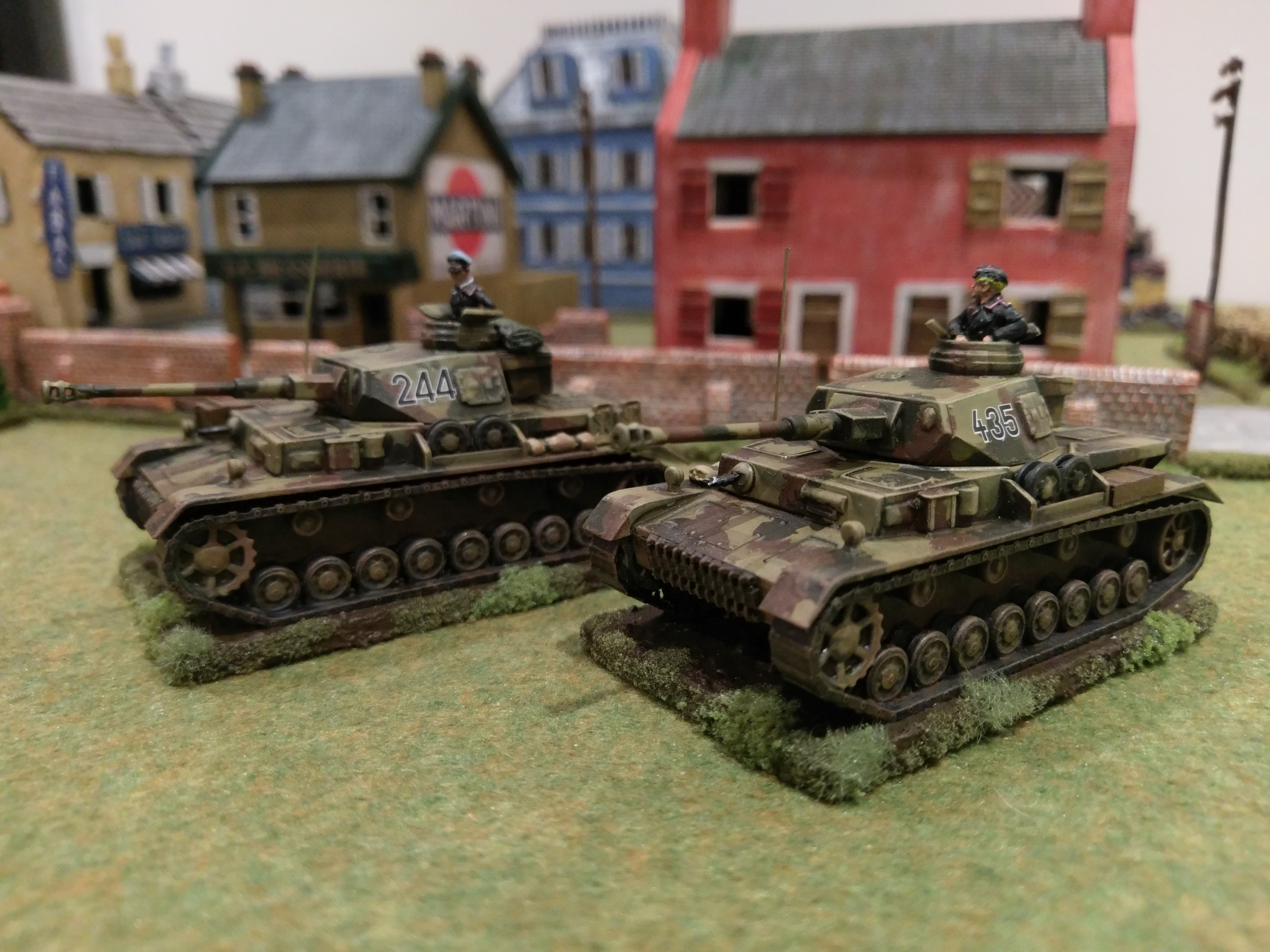
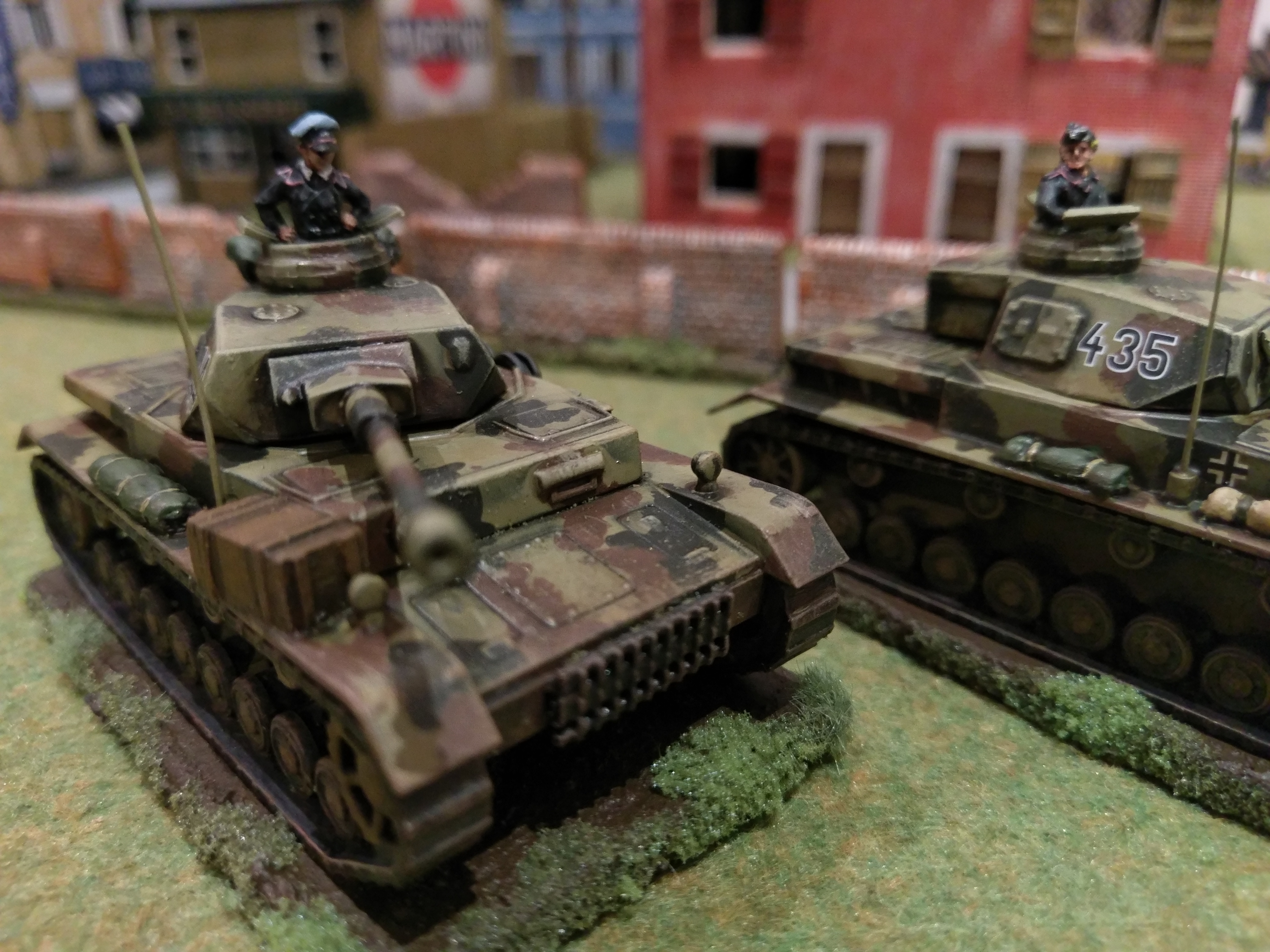
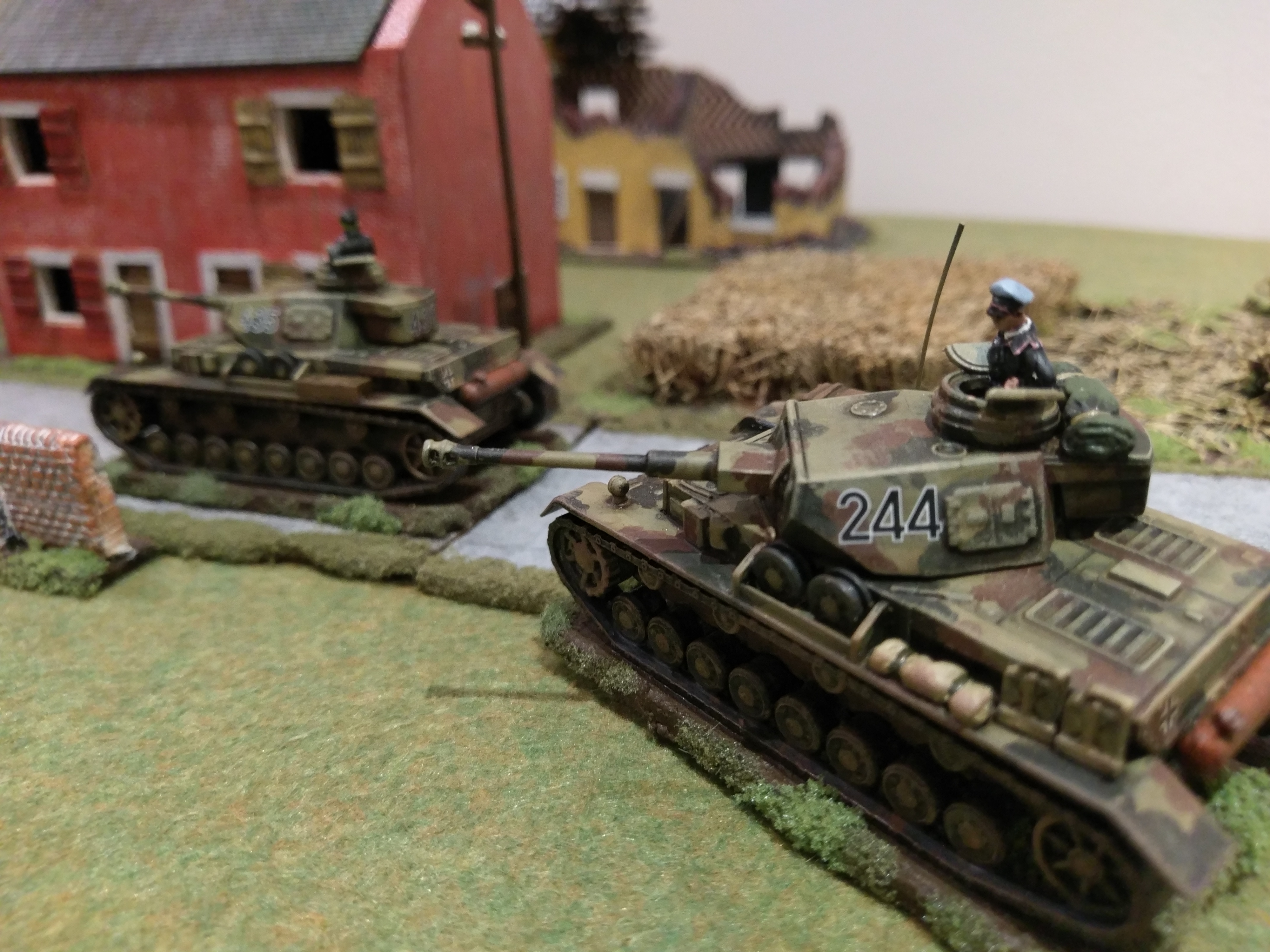
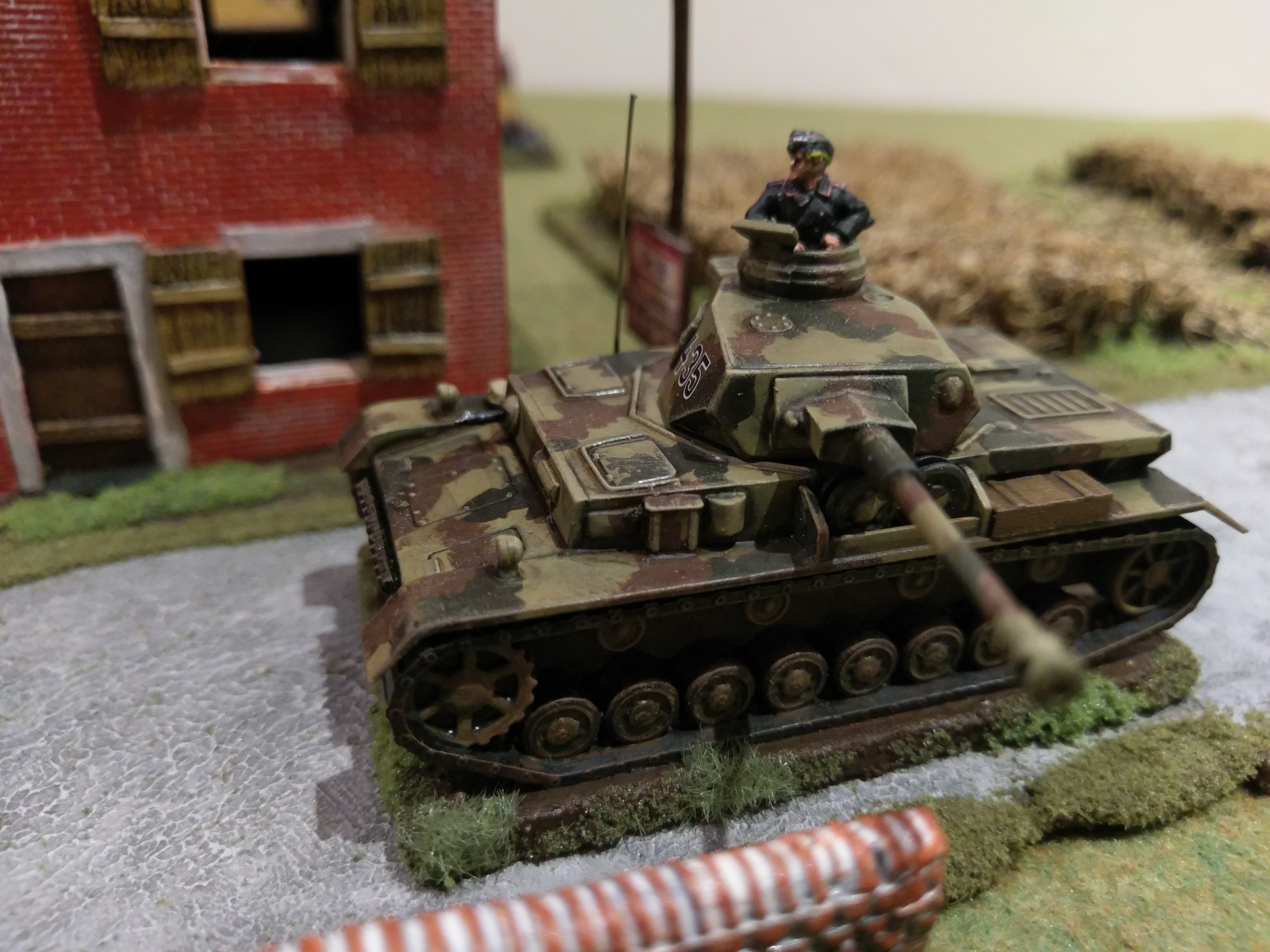
Revell PzKpfw III Ausf M in 1/72 scale

I had never made a model from German manufacturer Revell before but had read many good reports on most of their kits. The Panzer 3 Ausf M kit has always got rave reviews around the internet. I needed another to add to my two S-Model quick build kits and make a troop of three tanks. So i picked one up from Lucky Models in Hong Kong. Not the cheapest kits out there, but you really get what you pay for and this Revell model is worth every penny, or dollar.

There is nothing to say about this kit but good things. The wheels and lower hull go together nicely and everything is easy to align. The link and length tracks are the best i have made yet, and make it easy to make great looking tracks. I didn’t follow the instructions at this stage as i felt it would be easier to put the tracks on first before adding the upper hull. This was opposite to the guide. The upper hull has lots of detail to add including extra wheels and tow cables. The tank has a great little rear exhaust system and schurzen plates for the hull and turret. Extra track is supplied for the front of the vehicle plus some good decals with a couple of different options. You could leave the schurzen plates off if you wanted to make a less armoured version.

I gave him a black undercoat, a spray in Tamiya dark yellow, then did a two colour camouflage scheme based on the painting suggestion with the instructions. I painted the side schurzen plates separately before attaching them last so i could get the main tank painted more easily. Based as usual on MDF with some greenery he is ready to go with my other panzers! I have a Revell Tiger somewhere in my stocks so i am very excited to get on with building that now i know how good these kits are.

Hope you like the pictures below! Colonel M

In The Greenwood Laser Buildings Part 2

I finished the second building i had bought from In The Greenwood and was very happy how it turned out. This was was the Victorian Terrace with some nice looking bay windows. Flat packed brilliantly into a small cardboard box these kits are really cool. They scale out quite nicely to my 1/72 scale stuff, i think being around 110 – 115mm high. Only costing around $20 on line, probably less now since Brexit, they are really good value compared to other MDF and resin model buildings.

Quite easy to build, i only struggled a bit with the bay windows, and didn’t get them totally square or straight….. next time i will do better. Although the designs are not necessarily for Normandy they fit in really well with all my other buildings, most of which are home made. The addition of some French looking adverts and signs will help the houses blend into the Normandy countryside. I have a corner shop left to build which i will get to next.

The backyards are particularly nice, with some sheds and outbuildings. I added a path and some grass out back to the rear gates. Just ready for some troops to hide out there ready for action…… Its turning into a smart looking MDF street.


Dragon Models Sherman M4A3 (105mm) 1/72 scale

You can never have enough Sherman tanks. Ever. There is always room for another Sherman in the far corners of your tank units. This one is the up gunned M4A3 with a 105mm howitzer from Dragon Models. This tank was mainly used by US forces and from what i have read sometimes showed up with Canadian tank units. Mine was going to join my British forces, probably on loan or stolen or something like that.

My experience with Dragon Models has always been great. It’s been a love love relationship. However, this little Sherman changed all that. Dragon kits are always more expensive than others but you get a better standard of detail and their kits are usually great to put together. This Sherman kit had a couple of nagging problems that made it hard work. First up the lower hull section is too long for the top half of the hull and the two do not fit together. I had to shave off at least 3mm off its rear lower hull to get the top half of the hull to fit. After sanding off the back the rear vent section did not have enough room to fit over the exhausts and so had to be cut in half. Annoying. My other gripe was that the tracks were too short, even after i stretched them by hand. The Dragon track do not stretch much, and they ended up around 1 track link too short. I added in bits of a Unimodel M10 kit which filled in the track link gaps i was left with. Please Dragon make your tracks a little bit on the long side, then at least you can cut them down.

My whining aside the kit turned out really well, great detail and everything else you would expect from Dragon’s usual offerings. I added a British tank commander from Battlefield miniatures but kept the decals from the kit with US markings. Confusing i know but i really liked the decals and the big yellow “15”. Painted in the usual olive drab with some muddy weathering and MDF base i was pretty happy with the final result. You can never have enough Shermans whoever you are……

“Combat HQ World War Two Wargames Rules” by Jim Bambra

I was very excited to start playing with this new set of rules i found by Jim Bambra. After using Battlegroup Overlord for a while, i felt ready for a change, and to try something i hoped would be a bit more original and exciting.

The game revolves around six sided dice rolls, and sticks to this formula throughout the games processes. For a start this keeps things really simple and fast moving. For every action, reaction and result you throw a few dice and the game moves on. However, what i found most original and extremely playable was the way in which command and control of your units is handled. Traditionally a game would take the form of alternate moves ie each player would move and fire all his available units, then the other player would follow suit. You would probably get some kind of ambush fire order thrown in so moves could be interrupted. In Combat HQ each player rolls a number of command dice, determined by the size and type of force you are commanding, which are then formed into Dice Chains. So a chain can be made up of multiples of the same number, or if you throw 6’s they can be added to existing dice to make bigger chains or used as wild dice to affect orders in different ways. If you throw any 1’s in your command dice these may result in a command failure and end up being donated to your opponent who then can use them to expand his dice chains.

The significance of the dice chains is that players alternate orders or Command Pulses, each using a dice chain to move, rally, attack, disengage or other action, until each player has used up all their dice. The longer the dice chain the more you can do. So if you have a dice chain of say two dice you can make a double move, or you could rally units and then move, or any other combination of orders. So dice chains can be very powerful.

You form up to four units into Command groups and then activate them using a dice chain. So there is great flexibility for each commander to plan and execute his strategy while still affected by some good, or bad, luck. I feel the rules make game play very balanced between good strategy and good luck, rather than being random and annoying. If you roll a command failure and donate some dice to your opponent this can really tip the battle in their favour quickly.

Another excellent, and very simple idea that Jim has come up with, is that every unit may use opportunity fire during a turn. If an enemy unit fires or moves within your Line Of Sight then your unit may interrupt the move and fire, or fire simultaneously, if they have not already fired this turn. This negates the need for “overwatch” or “ambush” orders and is far more realistic i think. If you see the enemy then shoot.

Combat was quick and sometimes brutal, with tanks rolling attack dice against reaction dice, and results being suppression, dispersion and ultimately destruction. Each unit has different stats which are complex enough without being cumbersome. Again Jim reaches an excellent balance between realism, playability and fun!

In my battle from Charles Grant’s book, which i wrote about in my last blog, my British forces made very light work of a German tank group. Only losing a brave little Humber scout car the Brits managed to knock out a Puma, two Panzer 4’s, while leaving a third retreating and wounded. The Germans failed their morale before they could even fire up their troop of Panthers! If you are looking for a new set of rules you should check these out. Below are a few snaps of the game showing mainly burning wrecks.

Charles Grant’s “Battle – Practical Wargaming”

While Gavin Lyall’s “Operation Warboard” was my number one, go to rule book, back in the eighties, “Battle – Practical Wargaming”, by Charles Grant, was my silver medal, or my second most read volume. Actually both books were my big brothers, and i just used to borrow them and read them over and over again. I decided to reenact one of Charles Grant’s scenarios from the book. Its a very simple joust between some Panzer IVs and some T34s. I changed it a bit and had a couple of troops of Panthers and Panzer IVs take on a troop of Shermans and a troop of Cromwells.
I based my terrain on the map in the book which you can see below. It gave me a chance to try out my new folding tables i picked up on Gumtree. I also repainted all my river sections with a paint thickening medium to create a wavy texture, then gave them a coat of greeny brown acrylic paint, plus a top coat of gloss varnish. I was really happy with how the end result came out, far more realistic than my previous bright green and blue artificial looking waterways.

Funnily enough my big brother is lining up as the opposition in this little fight. Only 30 years on since i borrowed his book in the first place……… Will post some action shots when battle commences.

Armourfast Panzer IV

Armourfast make a big range of awesome kits for the wargamer. They come two tanks in the box for not much more than five dollars per tank. You really cannot get any better value than that anywhere in the 1/72 scale world of plastic models. I bought these Panzer IV’s to join my Italeri Panzer IV and make up a three tank troop. I have also previously blogged about the Armourfast Cromwell tanks, i think my first post back in October.

You know what you will get with Armourfast, two sprues (one per tank), and minimal parts. These panzers can be put together in minutes with their one piece track and running gear, two part hull and maybe four or five piece gun and turret. If you are looking for super detailed, accurate models, then these are not for you. But if you want good looking tanks, affordable, quick to build and ready to roll onto the table, then these are a great product.

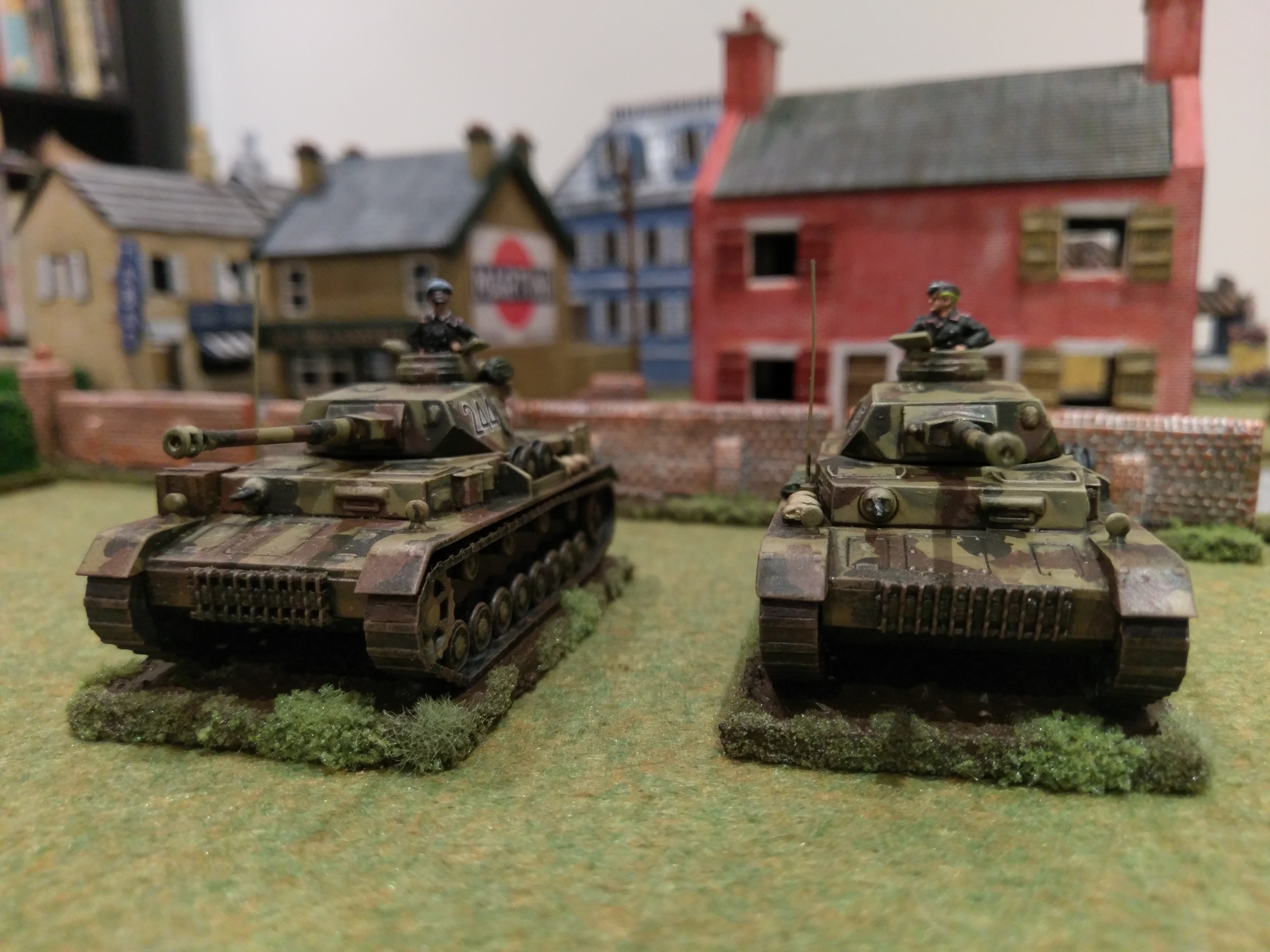
Best thing is you can dress them up a bit and add some bells and whistles. Adding some stowage items, a commander in the open hatch, and some decals really makes up for the basic detail of the kits. I added my own stowage from SHQ and Value Gear, commanders from AB figures and Battlefield miniatures, plus decals from my growing bag of spares. I tried out a different camo scheme, which is more of a blotchy three colour as opposed to my usual stripey ideas. Aerials also added from stretched sprue glued into the thoughtfully provided holes.

Overall another great offering from Armourfast and makes me want to run out and try more of their kits. Photos below as my brace of tanks enters the edge of town looking for a scrap……

IMAG0064 IMAG0063 IMAG0065 IMAG0066 IMAG0067 IMAG0069 IMAG0070 IMAG0068

Trumpeter Stug IV in 1/72 scale

Time to look at another cracking little kit from Trumpeter, who are fast becoming one of my favourite manufacturers. This time it is their Stug IV. Previously i had made the Dragon Models version of this cool tank and have included some photos of both of them together below as a comparison. Cost wise Trumpeter kits are approximately half the price of Dragon kits, but definitely not half the quality. This Stug IV is no exception.

The simple nature of the tank design, with no turret, means the kit is also quite simple. The most complicated and time consuming part is putting the wheels and running gear together and attaching them to the lower hull. The upper hull and armament are pretty straight forward but still have plenty of detail. The tracks i gave a good stretch before painting them and attaching them after the tank was completed and painted. Everything fitted together very nicely and the kit was smooth and painless to make. Just how i like it. To add some interest i put on a heap of boxes and other kit on the back of the tank. I have seen various photos of Stugs carrying all sorts of stowage, so i used some extras i had from Value Gear. If you haven’t tried out some of their stowage packs i can highly recommend them!

I finished the whole thing off with a dark green camouflage scheme to match my other Stug IV. Pictures follow, some individual shots of the Trumpeter kit and also some with his Dragon counterpart. They make a good team!

Ruined Buildings Part 3

So finally after all that construction it’s on to the paint job! Everything was painted a black acrylic as a base coat or primer. That gives the whole thing a good starting point and makes sure all the shadows are emphasized. I painted the undamaged rendered walls first, one a sand colour and one a pale blue. The insides were all painted a dark grey as more than likely they would have burnt in the fires/explosions that must have occurred. Previously i have used wrapping paper with a very small pattern on it as wallpaper. You could easily find a pattern on line and then print it out to a small scale to use as wallpaper for some of the internal walls.

The rubble and debris was also painted dark grey and then dry brushed with lighter shades to a very light grey. The exposed brick was painted a mix of bright red and a terracotta red. I also painted random bits of debris with the same red as many bricks would have fallen around the house. To illustrate the mortar i used a fine brush and a light grey to draw thin lines in between the detail on the exposed brick. The bits of wood on the floor, the roof beams and the internal floors were all painted a dark brown. I left plenty of black on the roof beams to suggest the charred nature of the remains. All the window lintels and shutters were painted white, and needed a couple of coats to get them right. I just used a black biro to draw on the shutters, much easier than a paint brush.

The roof tiles were painted grey and then randomly painted with lighter greys to mix them up a bit. I left plenty of black areas near to blast holes. Finally i lightly brushed black around all the damaged bits to show the extra effects of smoke. To add that extra bit of detail i found some cool French signs on the internet, printed them out and stuck them on the buildings with a lot of PVA glue so they look painted on. A bit of green flock on the base and hey presto the finished ruins.

See my photos below including some British units just nosing around in the smoky ruins! Over and out Colonel Mustard.


Ruined Buildings Part 2

I have continued working on my ruined buildings, and have decided to split the process into three blogs as otherwise it would be a bit heavy on the pictures. However, I did want to detail each part of the construction, so here goes!

To create the piles of debris inside and outside the ruins i first glued lumps of modelling clay at positions on the base next to the walls. I did this both on the interior and exterior in a random way, still leaving decent areas of the interior floor bare. I then covered these raised areas in PVA glue and sprinkled a decent amount of dirt/gravel from my front pathway on top. The stuff out the front of our house is perfect for producing random debris. You can see the construction taking shape below.

Next up i need to add a texture or render effect on the walls to get rid of the smooth finish of the foam board. I do this by mixing a fine sand (pinched from the play ground around the corner) with a paint thickening medium i found in my art box. You could do the same with sand and PVA glue mixed up. I then paint a liberal layer of the stuff onto all the exposed walls, making sure to stay away from the exposed brickwork and the window frames, and let it dry. This makes an excellent texture to paint on the outside of the houses.

To add a bit more character i needed to make more rubble and debris for around the place. The rubble i made with more modelling clay by rolling out a large flat piece to about 1-2mm thick and when it was half dry cut it into small cubes. I made a big pile of bricks and rubble this way. I also chopped up bits of balsa wood into broken beams and bits of roof. This extra debris was then glued on top of the original piles, and new small piles were also added just using the new rubble.

The whole building was then painted with black acrylic. Be careful not to use a cheap spray paint on foamboard as it can dissolve the inner foam part, and therefore would destroy all your hard work carving the brickwork. Last but not least i made a framework for the roof sections out of balsa wood and roof tiles out of more modelling clay. The damaged removable first floor sections were also made with balsa wood. I just drew floorboards onto the balsa wood using a biro which creates a decent paintable effect. So now all the bits are made all that is if left is to paint and construct. We will see the end result in Part 3!

20160430_074755


Ruined Buildings Part 1

I wanted to make some more ruined and battle damaged buildings for my table top, and thought i would document the process with the help of Colonel Mustard.

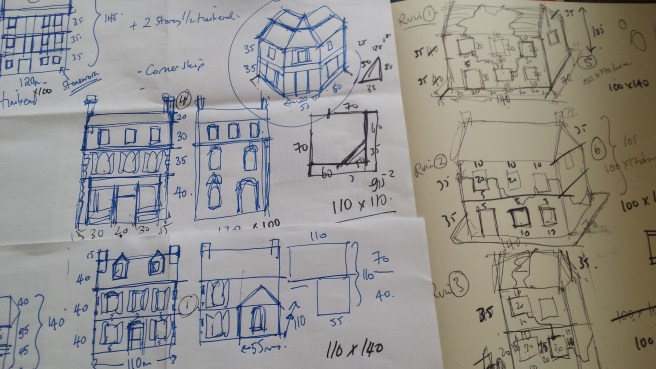
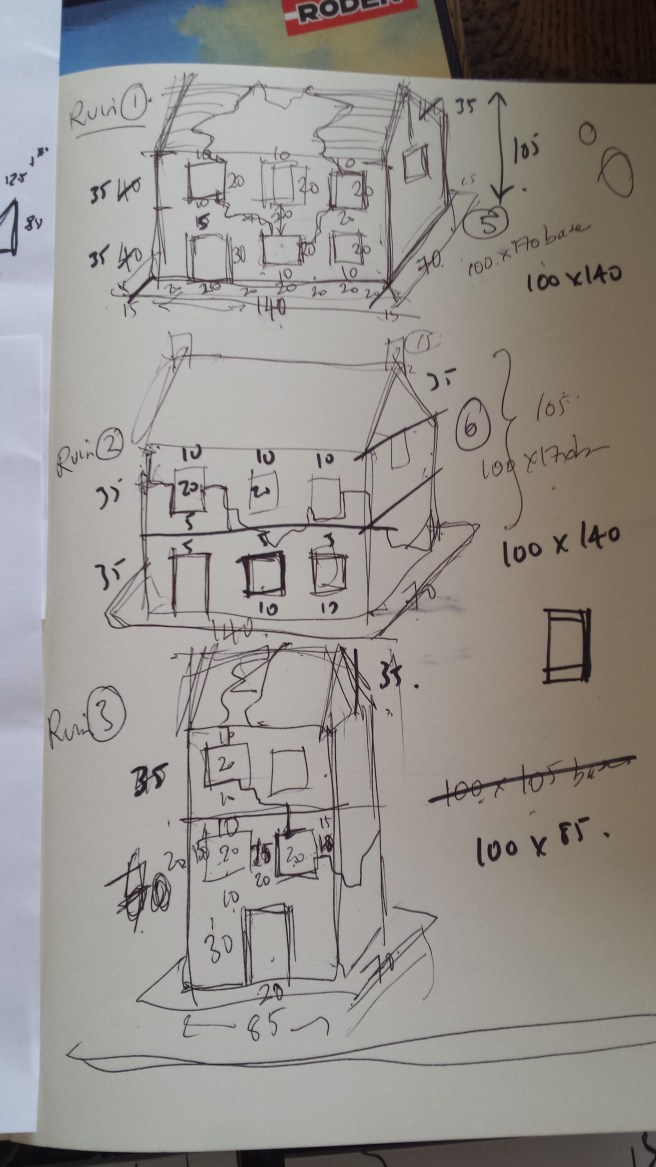
First up i drew up some rough plans and designs. There are plenty of places to get inspiration, the internet being the most obvious. I settled on making a house that has its centre completely blown out and a half flattened, heavily damaged cottage. I use 40mm per storey as my basic measurement (although in my drawings i did change to 35mm but then changed my mind back). Doors are 15mm x 30mm tall and windows 20mm square. I sketch out the basic plan and measurements as you can see below.

20160422_12370720160422_123841

For the base i use a 15mm border around the bottom of the building. In this case i only put a border around the front and back as i wanted to be able to place the ruins adjacent to each other with no gap to form a ruined terrace. My next step is to cut bases out of 3mm MDF, making sure you calculate the correct width and length of your building plus any border required. I then draw my building design onto 5mm foamboard. Most houses end up as four pieces as they are no more complicated than a box. I guess this is why i object to paying through the nose for purchased buildings as they are little more than an MDF or plastic or resin box that is decorated! I can do that for less than $30 per house.

Once you have accurately drawn your building cut it out carefully using a sharp knife. Try and keep the knife perpendicular so you cut straight through the foam and don’t leave any wonky angles. Cut out all the window and door frames too.

20160422_123751

I then cut away some of the card covering on the foamboard where the building render has been damaged. You can draw guidelines around some of the damaged walls and then cut through the card outer layer. Slide your knife under the card layer and peel if off carefully. Then with a ballpoint pen draw on exposed brickwork. When you press on the foam core it creates a texture which looks really good. Then its glue your box together on the base  with PVA glue and leave to dry.

Then its a question of cutting out 20mm x 5mm sections of balsa wood and gluing them into the windows as frames. i also add 20mm x 5mm balsa wood as window mantels and lintels. Above the doors i also put a 15mm x 5mm lintel. On the inside walls i add balsa wood beams halfway up the building, which indicate where the floor would have been, or if you do put some floor in they can act as supports.

At this stage our ruins look like this. In my next post we will do the building texture, rubble and debris, the roof and finally painting!