Metcalfe Models Terraced Houses and Corner Shop HO/OO Scale

I have continued building my Normandy village and trying to mix my home made, scratch built, but time consuming houses, with some purchased models. This time i have made some more of Metcalfe Models excellent card models. One grey stone terraced houses with backyards and a similar grey stone corner shop. Metcalfe Models do not ship overseas so i had to buy them from another useful modelling ship called Antics On Line. I think they are around 9-10 pounds per kit, so pretty good value compared to other resin and MDF buildings.

The quality of the card and the printing is most excellent. I do remember my brother back in the 1980s building some Superquick card models which always felt a bit flimsy and never looked like anything but rather crap card model kits. The Metcalfe kits are really well designed and once you have put them together feel very solid, robust and anything but a wobbly bit of card. Its all printed on good heavy card and all the bits pop out very easily once you have cut along certain edges with a sharp knife. During the construction there are plenty of inner supports which keep the whole thing very square and stable. The windows work well and even give you options to have a couple open as well as other options for curtains and different coloured doors. The buildings are mounted onto their own card base and Metcalfe give you individual adhesive paving stones to create your own pavement around the houses. In my build i left off the bay window on the terrace as i didn’t think they had those in France in the 1940’s. The dormer windows on the roof did remind me of a typical Normandy house so i think they do not look out of place. One thing i do need to fix is the corner shop is O’Briens Bakery. I need to find an alternative Boulangerie sign.

OK so after finishing your model you do need to rough it up a bit. I used plenty of powdered chalk in black, brown and white brushed all over the place. This covers any white bits of cardboard and also gives the houses a more weathered, realistic look. I also glued the whole thing onto a 3mm MDF base and weighted it down. Otherwise i did have some significant curling up around the edges. It also gives it more strength.

Next up i am making a new town square so will place that into the middle of my now quite sizeable Normandy village. Still need to make that church……..

Galmanche Scenario with Combat HQ

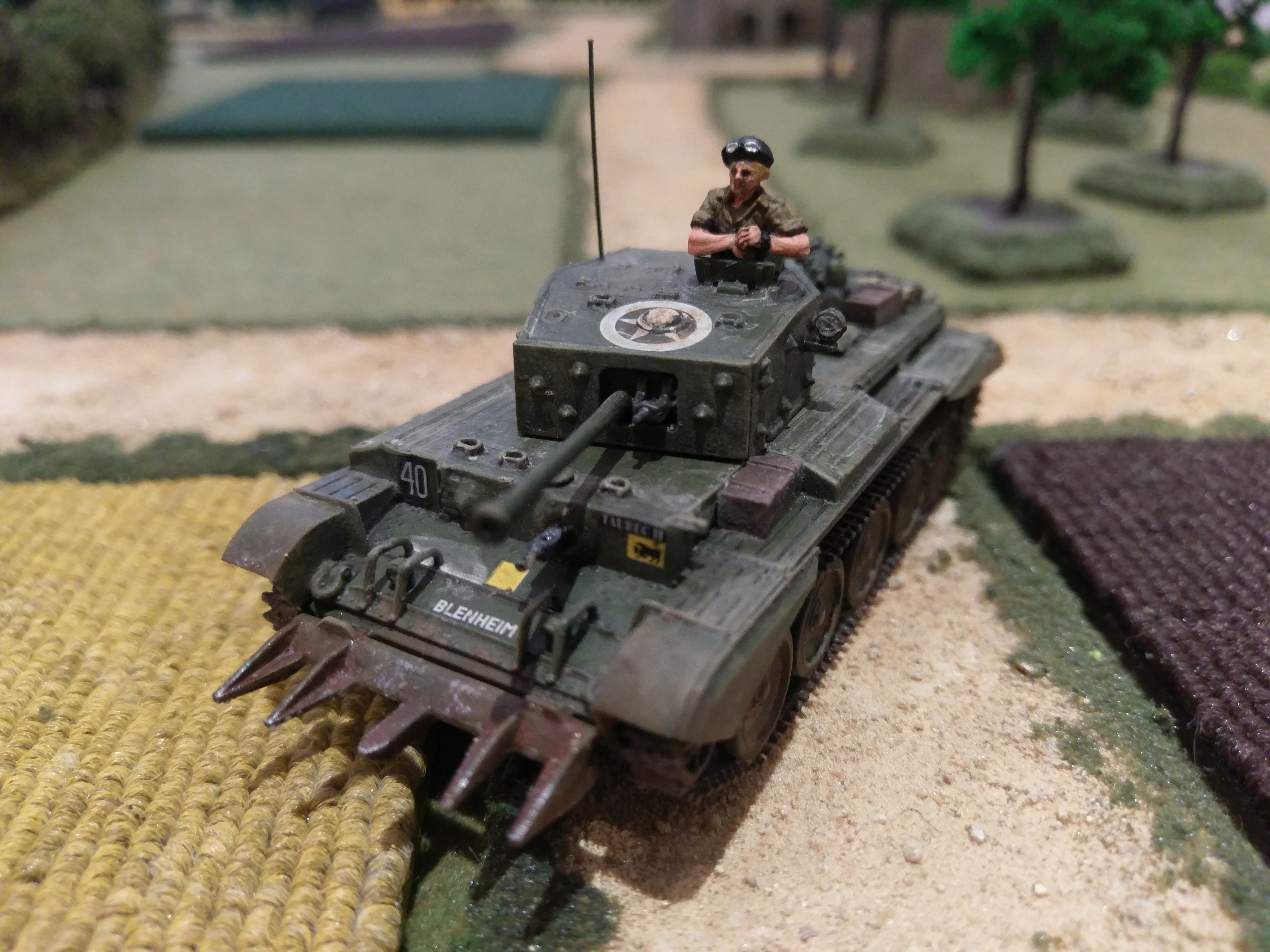
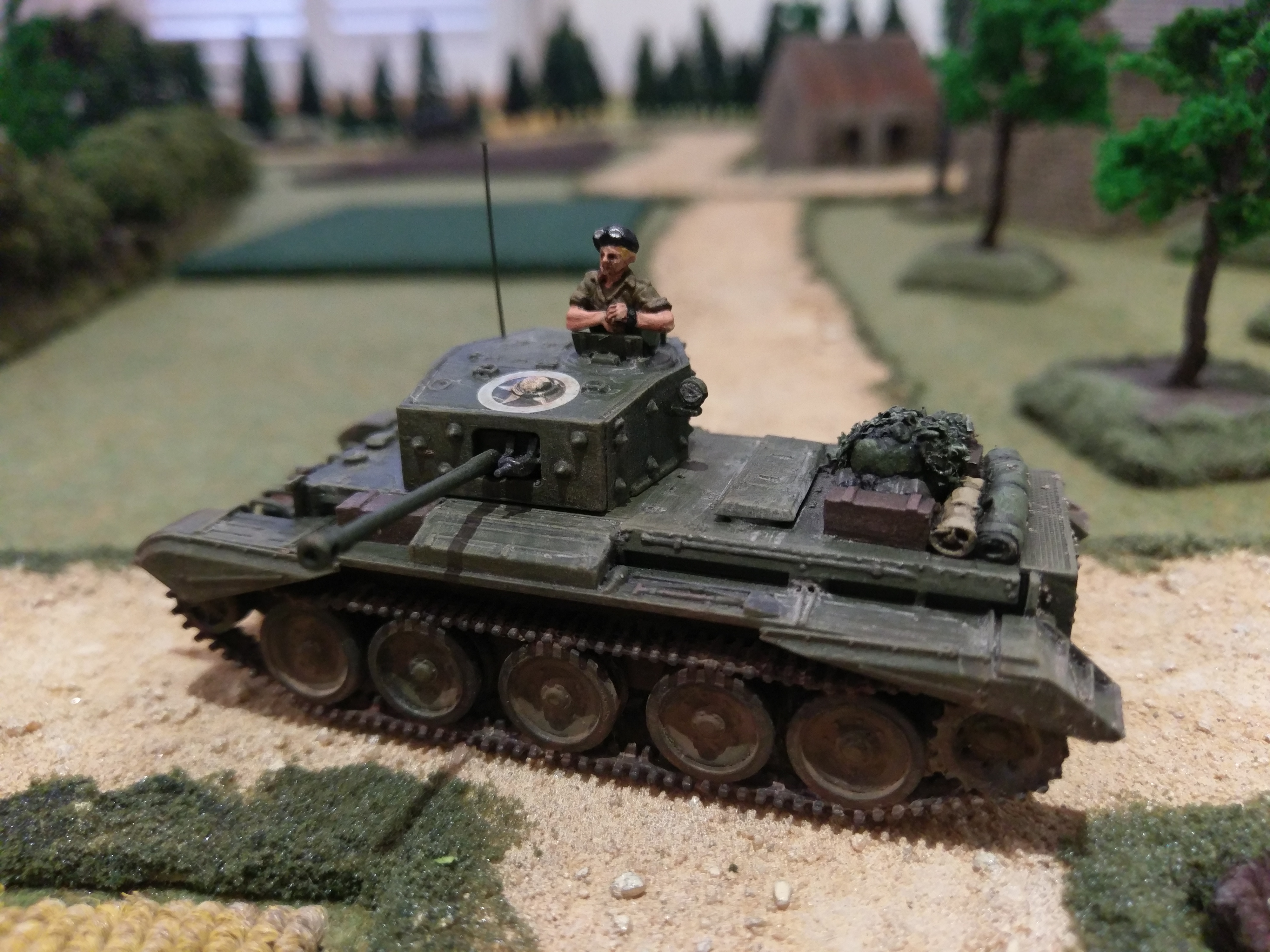
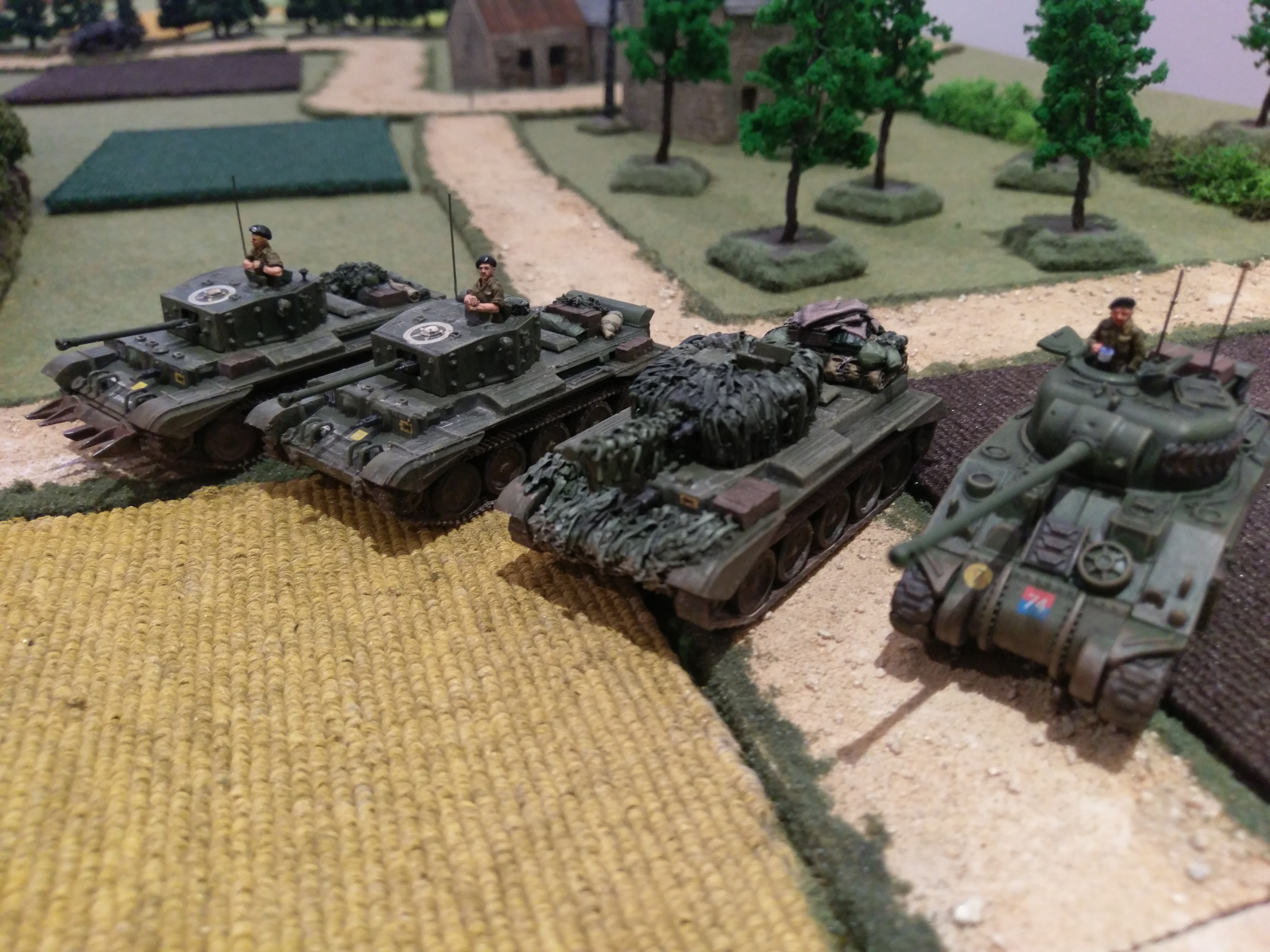
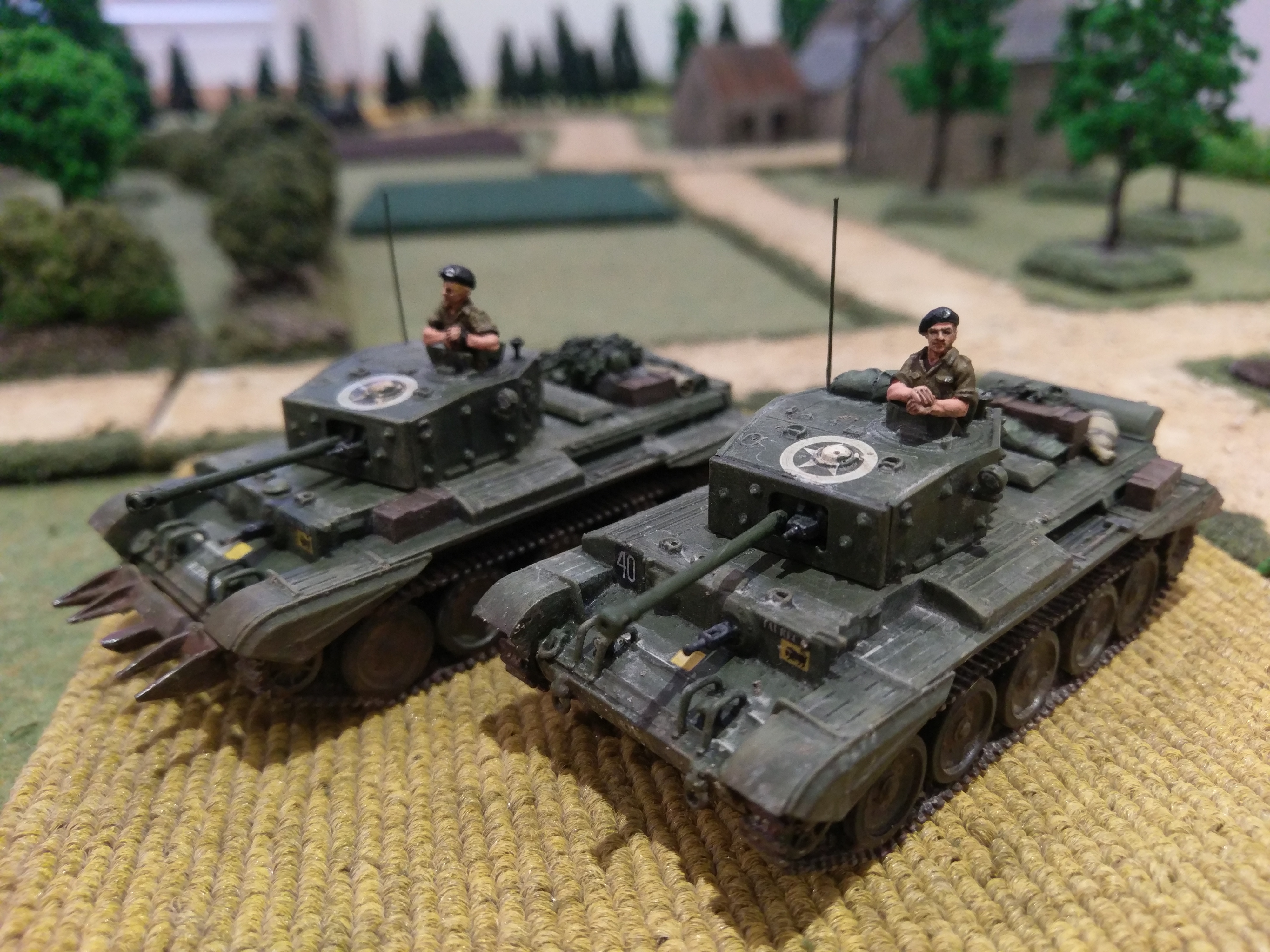
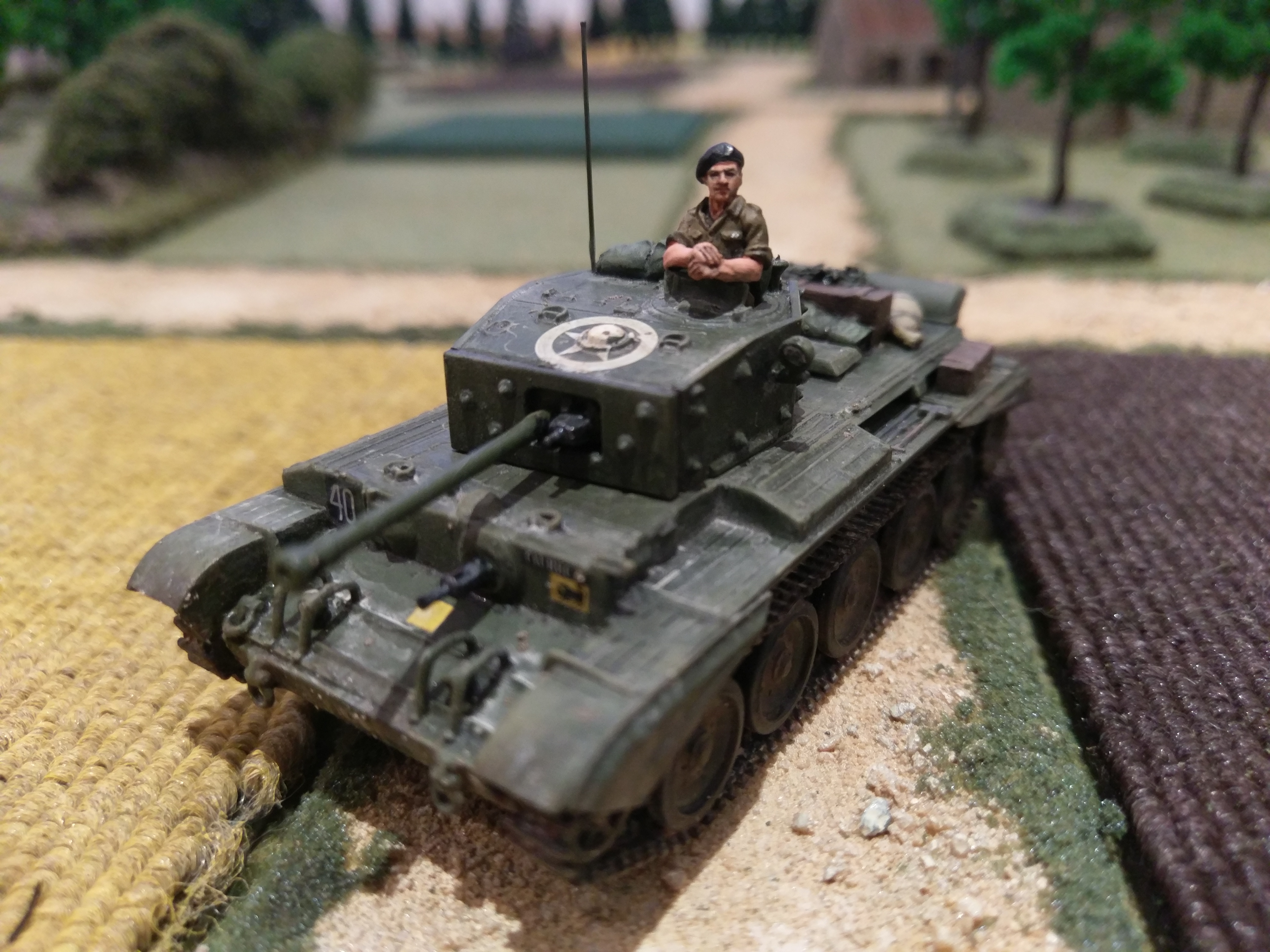
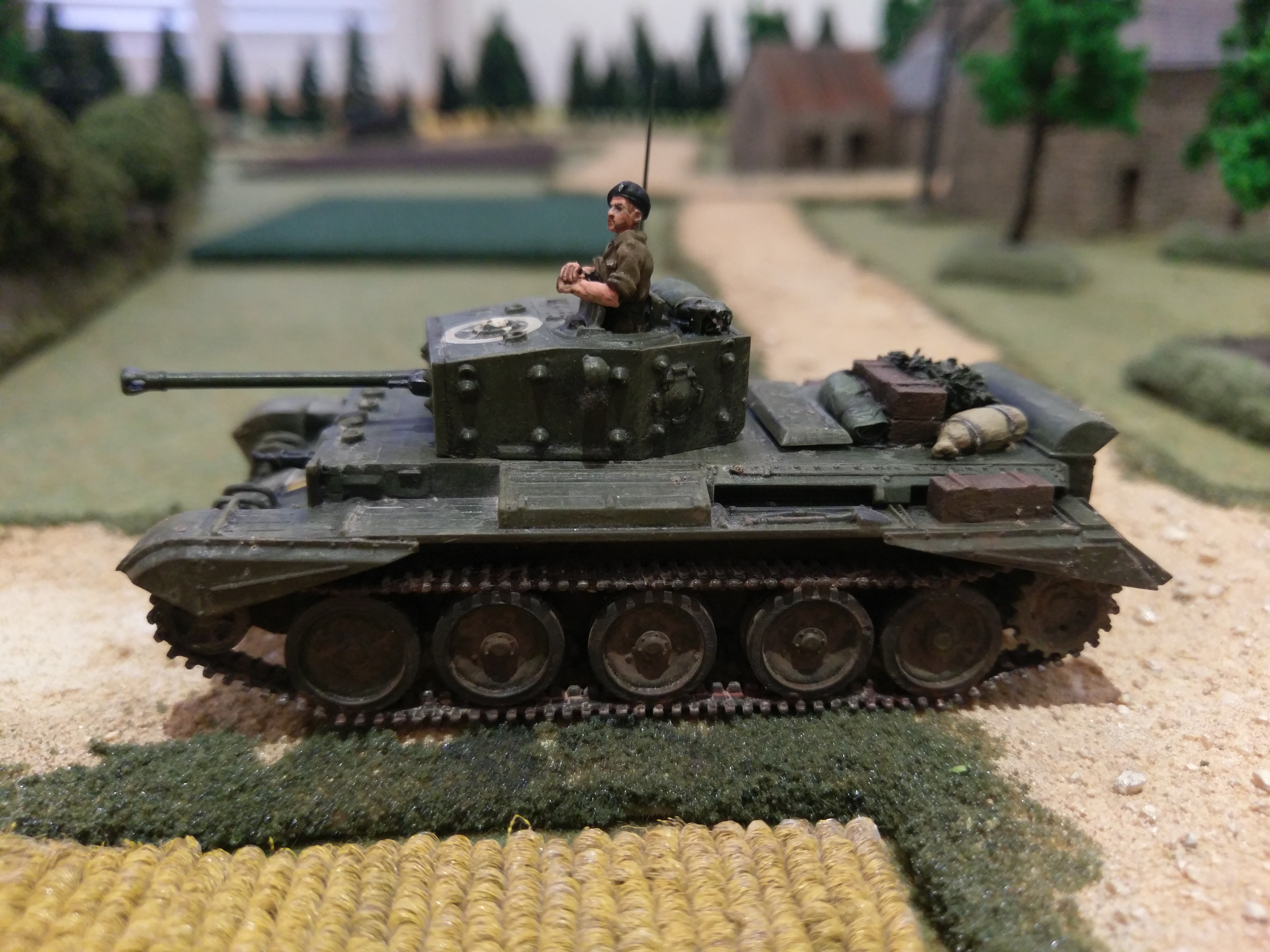
Even though i was not too keen on on Too Fat Lardies I Aint Been Shot Mum, due to the card activation system they have over there, i do like their scenarios. I thought i would give one a go using the Combat HQ rules that i have been playing with. The map was pretty straight forward with two small hamlets behind a wall of trees East – West as per the photo below. The trees across the middle are impassable to vehicles. The ploughed fields, wheat fields and orchards i counted as broken ground. Orchards provide light cover to anyone in them. All hedges were light cover and minor obstacles. The Germans were defending with three platoons of three sections each armed with a panzerfaust. Also an HQ with a Panzershreck, a Pak 40 AT Gun with tow, a Forward Observer commanding a battery of mortars off table, but no armour. They could set up concealed anywhere South of the tree line. The British consisted of a company (3 platoons of 3 sections), two troops of tanks (3 Cromwells, 1 Firefly per troop), a Company HQ of PIAT and Light Mortar, plus a Forward Observer in a Dingo Scout Car. They could enter from the North East corner. The British had to drive out the Germans from all the houses to win. The Germans had to hold at least three buildings to win. Morale failure by either side would also end the game.
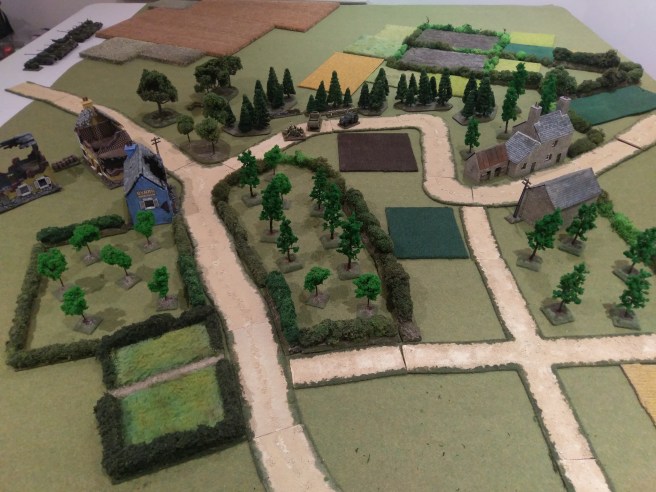
Galmanche

First up i like to have all my squads individually based. Rather than using the basing convention of 3 figures to a squad as per the Combat HQ rules i just use individual figures that must remain within 1 inch of each other. It means the squad foot print is larger so your command groups of infantry can cover more area. It does not make any difference to anything else. As each German section contains a panzerfaust it means I can have 1 figure in each section carrying one, then when he has taken his shot I switch him out for a rifleman. This negates the paperwork requirement of tracking who has fired his panzerfaust and who hasn’t. Also I bave many cool panzerfaust firing figures so i want to use them. I also tripled the range of the panzerfaust to 3/6/9 inches (Short/Effective/Long) as the Germans were at such a disadvantage to the British armour. The ranges for panzerfausts and panzershrecks are on the short side and they need to be increased to give them any chance of ambushing tanks. Otherwise they end up being pounded by HE and every attack is a suicide run to get close to their targets. I also use Forward Observers as dedicated units in my version of Combat HQ, and if they are destroyed you get a higher Target Number when requesting support (+1) if not a FOO making the request.

Anyway enough rule chat, onto the action. The Brits attacked with a full platoon, FOO and one troop of tanks down the East side heading for the farmhouse, and another platoon heading for the middle of the trees, and kept the third platoon and second troop off the board.

Here we see British advance on the right flank and the German FOO in the trees. The British got their 25 pdr battery going early onto the tree line and caused a bit of suppression. The Germans suffered badly from terrible command dice rolling and had at least four command failures giving the British 2 or more extra dice. Early on the British armour was able to make a number of double and triple moves, with the speedy Cromwells avoiding the German mortar rounds and getting close to the farmhouse. Only a squad was defending  the farm and once their panzerfaust missed its target the Cromwells wiped out the whole squad with MG fire.

Above German Mortar fire getting a bead on advancing armour and doing very little damage. One of many command dice failures by the Germans (black dice). The Cromwells get up close and wipe out the squad in front of the Farm.

IMAG1081More Germans move to try and defend the farm, still under artillery fire. Already the British grabbing initative with their excellent command dice rolls was having an impact with the Germans having to react with fewer order dice.

In the middle of the trees the British attacked the one German squad that was dug in and managed to close assault with two sections. Close Assault is deadly in Combat HQ. The German squad was annihilated for the cost of one British section. Another German squad made a double move and managed to wipe out the British section in Close Assault, who were in turn wiped out by the remaining British section from that platoon. Suddenly the Germans had lost 3 squads quickly and the British were in the trees.

The tank troop on the East flank continued to maneuver around the farm to the South with a plan to attack the Germans from the rear. The German commander was now realising he should have moved his Pak 40 AT Gun earlier. His only option was to send the panzershreck team to try and intercept the Allied Armour. Throughout the whole of the game German AT weapons were thoroughly useless and on another day they could have won the game. Meanwhile the second British tank troop came charging towards the Western houses, so at least the Pak 40 gunners could warm up some shells and get ready for some action.

The panzershreck team couldnt hit a barn door and get wiped out by the Cromwells, who continue at a fast pace and get behind the AT Gun who is set up at the Western crossroads. The Farm buildings in the East are taken by the full platoon of British infantry. Finally the Germans hiding in the West end of the trees manage to ambush the second troop and blow up one Cromwell. And finally the AT Gun is turned around and hits the approaching Cromwell from the South. However this exposes his backside to the oncoming second troop who quickly blow him to pieces. More misses from panzerfausts in the ruined houses and the game is up for the Germans as their morale drops below zero.

So a good fast game, which the British won very easily due to quite excellent command dice roles always giving them a big advantage in orders. The Germans defended OK but should have had their AT gun in a more useful position, and they also left themselves a bit thin trying to defend the whole front rather than concentrating on one area. If they had scored a few more kills with their AT weapons it may have been a different story.

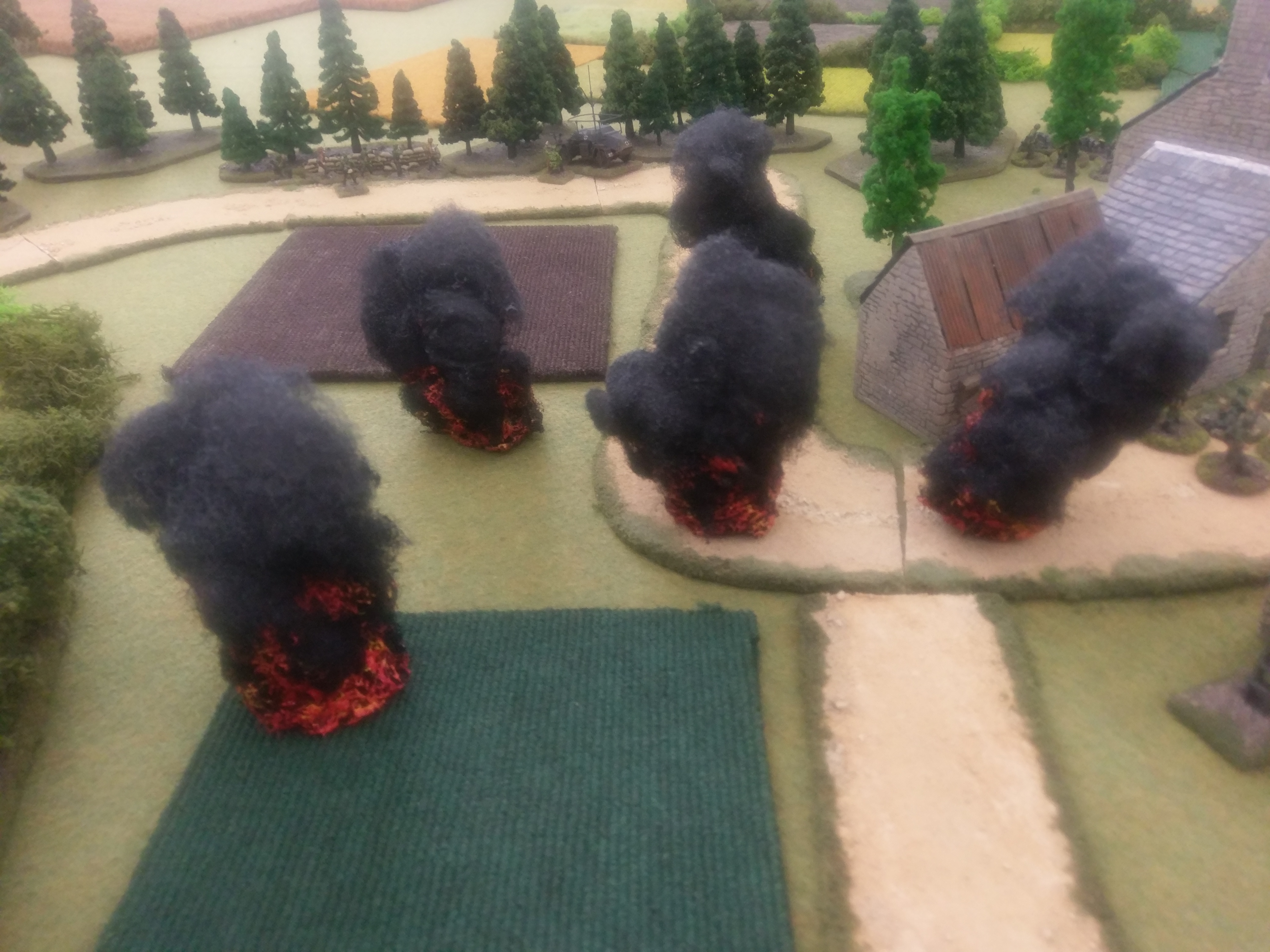
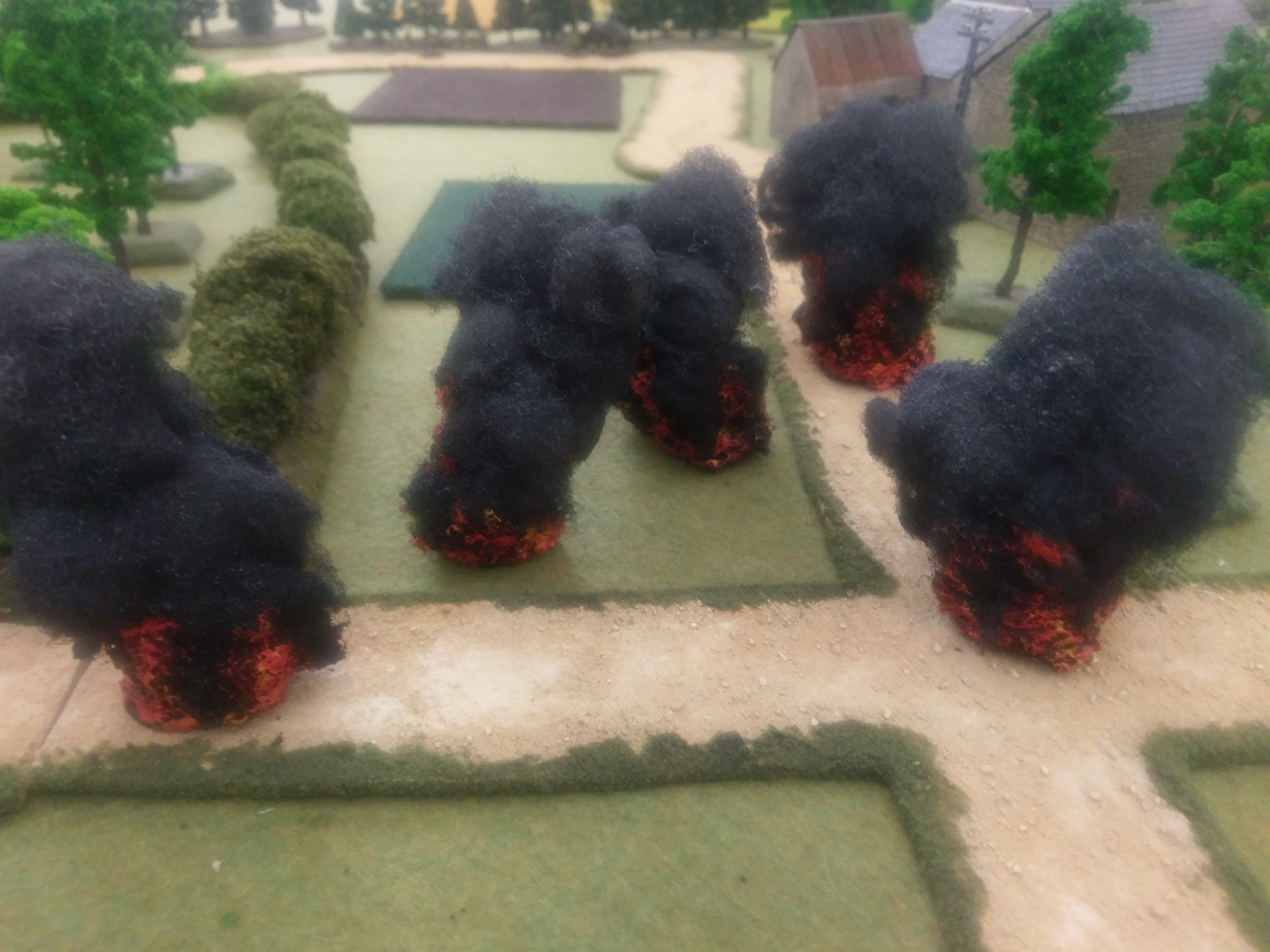
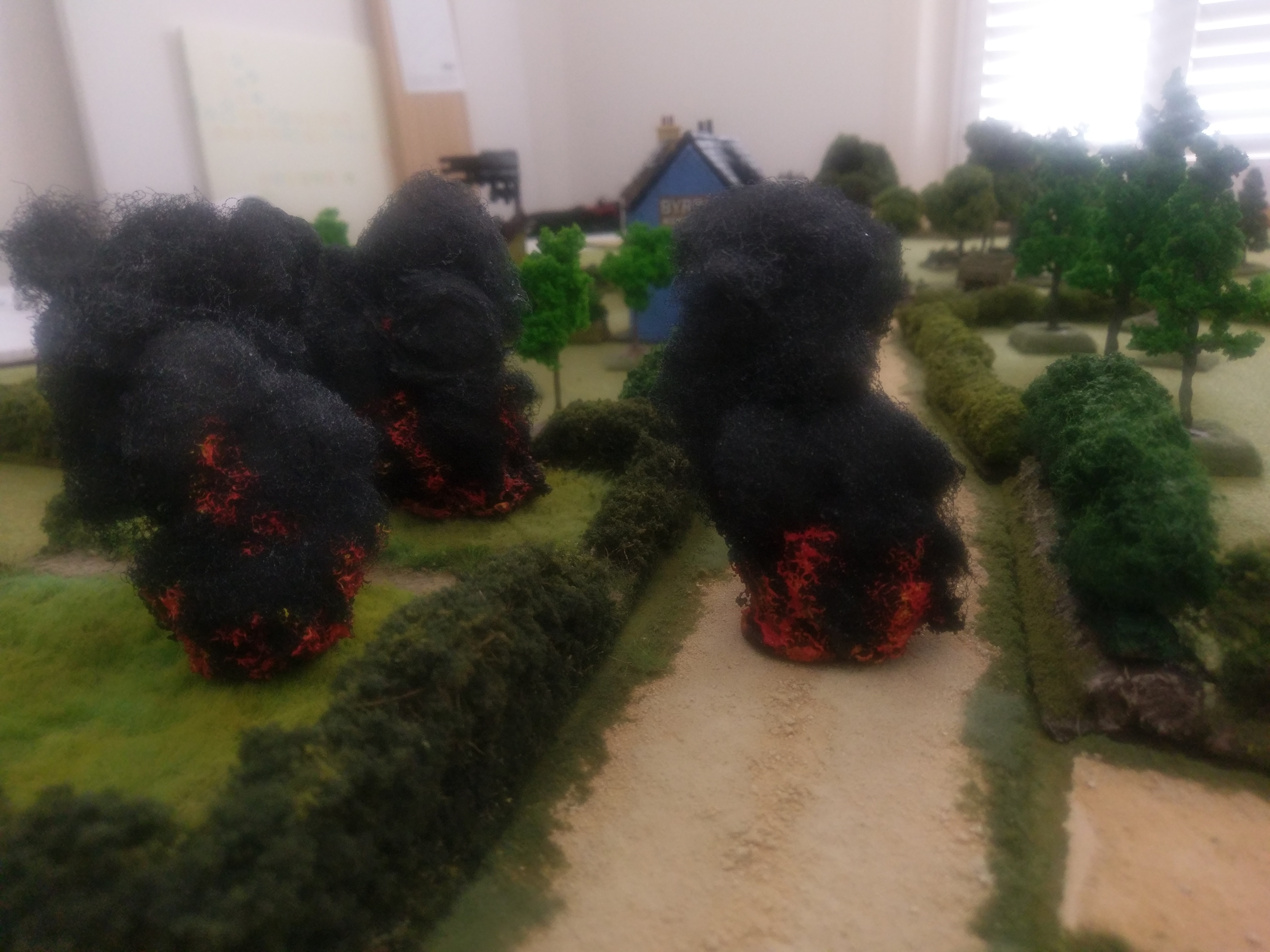
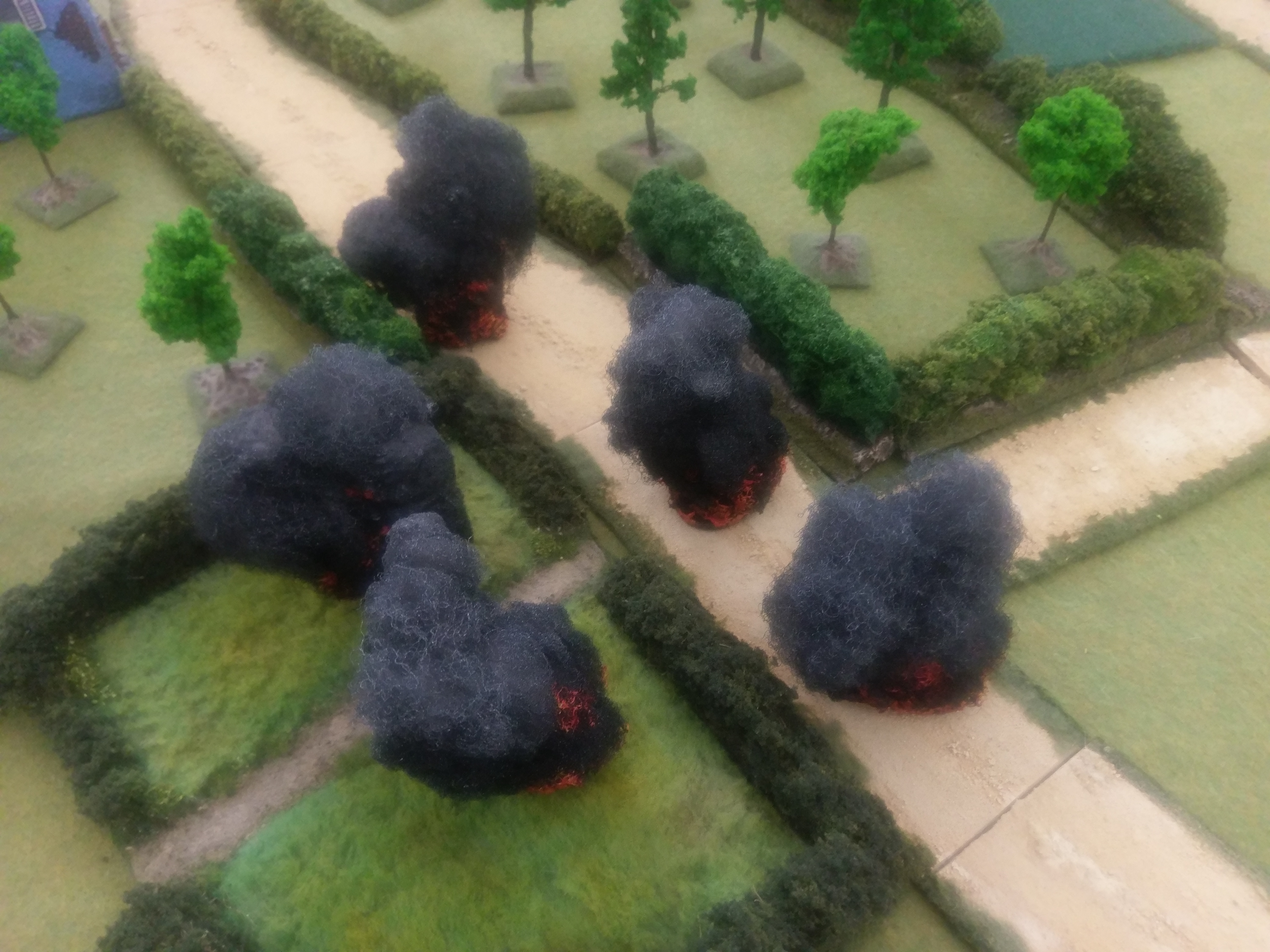
Explosion Markers

I quickly knocked up some more explosion and artillery markers. Plenty of ways to do this. I used 20 cent coins and super glued twisted bits of wire to the coins to create a structure. Then using poly fibre and cotton wool and lots of PVA glue i wrapped the wire structures up all the way to the coin. When this was dry i added plenty more PVA glue and some sand all around the coin and bottom end of the explosion. This creates a bit more weight and texture nearer ground level. When this is dry i sprayed the whole lot with flat black and then some light grey and some white to add some variation. At the bottom i use red and yellow acrylic paint to represent flames. After that i gave them another spray with some matt varnish. They came out quite well i think – check them out below. I will use them in the game i about to play using Jim Bambras excellent Combat HQ rules.

Country Roads

The Colonel has been on the road, traveling overseas the past few weeks, and only just returned to blog land. I had been working on some country roads as an alternative to my tarmac versions, and this week i finally got them finished. No Normandy battlefield would be complete without some good looking dirt roads.

Roads are one of the more simple terrain pieces to make, so i am not sure why anyone would buy any commercially made, expensive items, when you can make good looking roads for next to nothing. I am planning on playing a scenario from the “I Aint Been Shot Mum” rules so made enough roads for the map in the rulebook.

Its a very simple process. I drew my roads onto a sheet of 3mm MDF and then cut them out using a stanley knife and a handsaw. I made sure every horizontal cut was 8cm wide so all the road sections would fit together. I tried to avoid any straight lines as nothing is ever straight. Then a quick sand of all the rough edges and we are ready to decorate. I used a mix of PVA glue and a paint thickening medium to cover the road surface, and then a decent sprinkling of fine and coarse sand and some grit all mixed up. This gives the road a random texture. When this was dry i did add another round of the gritty mix down the middle of the roads as that is where the bigger stones etc could settle. The sand colours are pretty good but i did give them all a quick spray with a cream colour which blended everything together. The finishing touch was two different flocks along the edge and some random tufts. Check them out, you will see them in an after action report i plan on doing soon!

Metcalfe Models Coaching Inn HO/OO Scale (1/72)

I have slowly been expanding my Normandy village with a mixture of buildings from various sources. I much prefer to try and build all my own stuff but it does tend to be very time consuming, so i do like to boost my output with some purchased structures too. The good thing about building your own is that you can create whatever you like and to size with your other scenery. I have found a big difference in heights of purchased houses, making some products unusable. For example i did buy a house from Loic Neveu but it was more like a 15mm building and looked silly with my other buildings. Shame as they are really nice models.

Anyway this Coaching Inn is a card model from the English company Metcalfe Models. They do not ship to Australia so i had to buy it through Antics On Line in the UK. Size wise this is over 120mm tall and fits beautifully with my existing buildings. Its a well designed tough card model. Not too much cutting is involved and the instructions are clear and easy to follow. The acetate windows with details printed on are particular nice. Its not really a French looking building, but i think it fits well enough. They give you a choice of signs, of which i chose The Swan Inn, but i think i will print out something French to put over the top. I mounted my finished model onto 3mm MDF for extra strength. The edges of some of the card and also the building corners need a little touch up with a black marker pen just to tidy it up.

For around ten pounds i think this is great value for a really nice kit. I have a couple more other kits from Metcalfe which i will be making in the coming weeks. If you are looking for something other than resin, plastic or MDF for your table look no further. Some pictures below with the Inn flanked by a home made red brick building on one side and an MDF bought kit on the right. Then some shots of all my buildings quickly laid out.

Teddy Bear Fur Fields

My terrain projects continued with some more fields and hedges for my Normandy landscape. In recent weeks i have read a lot of excellent blogs and book articles on the use of Teddy Bear or faux fur so i was very keen to try it out for myself. One of the railway modelling books i have been reading goes into detail about how to use the fur in lots of different ways. The first one i wanted to try was just an open grassy wild field and also one enclosed by hedges with a dirt path running through it.

I picked up a large bit of beige faux fur from Spotlight for about $25. This should be enough for plenty of applications! I then cut out the size i wanted and glued each bit to 3mm MDF bases as usual with PVA glue. Then its attack the fur with a pair of sharp scissors and cut it to the length you want. For the wild grass fields i went pretty hard with a short back and sides and reduced the fur to 3-5mm long. You will see through experiment how long or short looks right for you. I tried using my beard trimmers on it too but they didn’t work. So stick to scissors! If i owned a comb i would have combed the fur to get all the cut bits out and also get it all pointing upright. I dont have a comb so i used my fingers which worked ok. For the path i just cut as close to the base fabric as i could removing all the fur where i wanted the track to go.

Then you can paint the fur using green, yellow and brown acrylics. Make sure you use as little paint as possible and use lots of different shades to get a natural look. The less paint you can use the quicker things will dry. I used a big paint brush (ie for painting walls) to blend all the paints throughout the fur and get a good covering so no original fur colour is left. That’s about as tricky as it gets. The path i just used PVA glue and sand and then some paint. I added little shrubs and weeds and tufts around the place. The hedges were made from horsehair and flock just like my bocage and trees. This fake fur is really handy and i was very happy with the results considering how cheap and easy the process was. I am planning to use it on some country road sides and also a canola field.

Check out my pictures below including the Sherman Firefly crossing the field (of Glory hopefully).

Making my own trees

You always need trees and plenty of them. I have been reading up on more tree making techniques, after the Chinese eBay technique was wearing a bit thin. Looking at railway modelling books and the internet i have seen many ways of using wire to make trees and thought i would give it a go. Starting with anywhere from 15 to 30 pieces of wire up to 15 cm in length i just put some masking tape around the bottom of the whole bundle to create a trunk. Make sure the tape is good and tight to stop the wires from separating. Then its just a question of twisting a number of wires together (3 or more depending on how thick you want the branches to be and how many of them you want). You need to try and create as random a look as possible. I tried lots of different ways of twisting wires together before i got a look that i was happy with. There is a bunch of Youtube stuff out there on this subject, with some people using drills and other devices. I found it easy enough by hand to create some good looking results. I then covered as much of the wire with masking tape nice and tightly, except for the end bits which if only 1 wire thick do not matter. The great thing is wire and masking tape cost very little and you can churn out some really good looking trees for a small outlay. Chinese eBay trees are nice and cheap too but these home made ones look far more natural (in my opinion).

After the tape i give the trees a good coat of a paint thickening medium, but could use PVA glue or filler or something similar. When thats dry i painted them with a mixture of raw umber, burnt umber and white. Tree trunks are a brown grey sort of colour. I did some highlights in a light grey and light brown too to pick out the gnarly details. For the foliage i had sourced some rubberized horsehair from the UK and used that with bits of coconut fibre. The coconut fibre is dirt cheap from Bunnings, while the rubberized horsehair is expensive, so i wanted to stretch the use of the horsehair. I am thinking maybe i could soak coconut fibre in PVA glue and compress it and make my own rubberized fibre. Once the foliage is glued to the wire armatures i used three different kinds of flock sprinkled over PVA glue. Other people use spray adhesive for this step but i found just brushing PVA glue onto the foliage and then sprinkling works well.

All the trees were mounted into MDF bases which are decorated and flocked. You can see with the bigger tree the wires at the base of the trunk can be splayed out and twisted to make big roots. Next up i need to make an apple orchard for my Normandy battlefields….. Tiny apples out of modelling clay. Golden Delicious anyone??

Farmyard Scratchbuild Part Two

I finally finished the second and third buildings for my Normandy farmyard. Inspired by David Wright and his brilliant book “Making Rural Buildings for Model Railways” i modelled my farm buildings on a couple of farms i saw in his book and on his web site. I had finished the main farm house and had to complete the small stable and the out house with hay loft and steps.

All made from a structure of 5mm foam core coated with plaster and modelling clay, that’s the easy bit! The time consuming effort comes with carving the stone work brick by brick. I bought a cheap engraving tool on eBay for $15 which definitely speeds the process up, although i did go change batteries quicker than undies. Roofs are all old Christmas cards cut up into tiles in strips glued onto a foam core structure, except for the rusty corrugated steel, which i picked up from Sergeants Mess for a couple of pounds.

I left the buildings all un-based and free standing so i could change their configuration into whatever i please. I will add a large hay barn next and make a farm yard stone wall and gate and path. Need some hay bales and a tractor to finish the whole thing off. Photos below with a sneaky Tiger wandering past.

Metcalfe Models 00/HO Scale Village Shop & Cafe

I built the second building from Metcalfe Models that i bought a while back. The first manor house was a bit on the small side to fit in with my other scratch built Normandy buildings so i was not too enthusiastic about this one. But i was happy to be surprised with how this turned out. Scale size is always a problem, especially with buildings. I did purchase one as a trial from Loic Neveu, who makes great looking stuff, but it was tiny! I reckon it would fit better with 15mm or 1/100 scale. My home made village all comes in around 40mm per storey or 120mm minimum height for a two storey building with roof. Plus the chimney pots and 3-5mm of base. This Metcalfe village shop is 110mm in height to the top of the chimneys which is just big enough to fit in with my existing buildings without looking shrunken and dwarfish. Once you stick him in with other scenery you don’t notice the slightly smaller scale.

So onto the model. I really like these card kits. They come in super solid card stock and are really fun and easy to build. A clear instruction sheet is provided and the card pieces are very clearly marked and self explanatory. It makes a nice change for an evening’s modelling excitement. The card does a look a bit too clean and tidy, so i find basing them and throwing some brown paint around does help them blend into the “real world” a bit. While i am super keen on building my own terrain from scratch having a few of these guys adds some variety and speeds up the process a bit too. Building my own takes me weeks and weeks. For around $15 – 17 per house they are very good value compared to other resin or plastic options. I have my beady eyes on a couple of other Metcalfe kits, the terraced houses and corner store may be added to my collection. You should check them out, even more so for you Cold War and Modern wargamers, as they will fit better in that period than in Normandy 1944.